

Article Summary
What this article covers: A comparison of flood legends from Mesopotamia, the Bible, China, India, Mesoamerica, Africa and the British Isles, set against the geological evidence for real post-glacial floods.
Who this is for: Readers researching comparative mythology, travellers interested in Celtic and world folklore, and anyone curious about why so many cultures tell the same drowning story.
Key takeaway: Flood legends repeat across unconnected cultures because rising seas and catastrophic floods were genuinely witnessed events, and oral tradition can carry the memory of a drowned coastline for thousands of years.
Expert insight: “Standing on the shore at Lough Neagh, you’re looking at a lake that Irish tradition says drowned a city. Ireland has its own version of the flood story, and it is written into the water itself.” , Ciaran Connolly, Founder of ConnollyCove
Quick facts:
- The Mesopotamian flood account in Tablet XI of the Epic of Gilgamesh predates the written Genesis narrative by roughly a thousand years
- Doggerland, a landmass connecting Britain to mainland Europe, was submerged by rising sea levels during the Mesolithic period
- Irish tradition preserves inundation stories at Lough Neagh, the River Shannon and the River Boyne, where an overflowing well drowns the land
Table of Contents
Ask most people about the great flood and they will name Noah. Ask a folklorist and you will get a much longer answer, because the story of a world drowned and remade turns up in Iraq, in China, in Guatemala, in Wales and in Australia, told by peoples who had no contact with one another. That repetition is what makes flood legends worth studying properly rather than listing.
ConnollyCove covers Irish heritage, Celtic mythology and cultural traditions worldwide, and the flood story sits at the point where all three meet. This guide compares the major flood legends side by side, looks at what the archaeology and geology actually support, and pays particular attention to the drowned lands of Ireland and the British Isles, which most global surveys of the subject skip entirely. If you want the wider context first, our guide to Irish mythology sets out the sources these Irish traditions come from.
Why Do Flood Legends Repeat Across Unconnected Cultures?
Flood legends recur because water is the one catastrophe every settled society faces. Rivers flood, coasts erode, ice melts, and people who farm floodplains or live on shorelines carry the memory forward. What surprises most readers is not that flood legends exist but that they resemble one another so closely, right down to details like the bird sent out to test for dry land.
How many flood legends are there?
Scholars have catalogued flood legends from every inhabited continent, with published surveys running to several hundred distinct narratives. The often-quoted figure of “over 200” comes from comparative folklore collections rather than a single authoritative census, so treat any precise number with caution. What matters more is the distribution. Flood legends appear in Mesopotamia, the Levant, Greece, India, China, Southeast Asia, Australia, the Pacific islands, Mesoamerica, the Andes, the North American plains, West and East Africa, and across northern Europe.
The motifs that repeat in flood legends
Six elements turn up again and again: divine anger or disturbance, a warned survivor, a vessel or refuge, the rescue of animals, a landing on high ground, and a sign that the waters will not return. Not every tradition contains all six. The Mesoamerican accounts, for instance, often have no vessel at all.
| Region | Legend | The trigger | The refuge | The sign |
|---|---|---|---|---|
| Mesopotamia | Utnapishtim | Decision of the gods | A great sealed boat | Birds released to find land |
| Israel/Judah | Noah | Human wickedness | The ark | The rainbow covenant |
| India | Manu | Cyclical renewal of the world | A boat towed by a fish | A new generation of life |
| Greece | Deucalion | The wickedness of mankind | A wooden chest | Landing on Mount Parnassus |
| Maya | The people of wood | Failure to honour the gods | No vessel | Transformation of survivors |
| Ireland | Liban at Lough Neagh | A sacred spring left uncovered | Escape by water | A lake where a city stood |
The table is worth reading twice. The Irish entry does not look like the Mesopotamian one, and that difference is the point: local flood legends usually explain a specific piece of landscape rather than the fate of the whole world.
The Oldest Written Flood Legends of the Ancient Near East
The earliest flood legends we can read rather than reconstruct come from Mesopotamia, written in cuneiform on clay tablets. Three related accounts survive, and together they form the deepest documented layer of the tradition. They matter because they show a story being retold and reshaped over roughly two thousand years within a single region.
Ziusudra, Atrahasis and Utnapishtim
The Sumerian flood account, sometimes called the Eridu Genesis, names the survivor Ziusudra. The Old Babylonian Atrahasis epic gives him another name and adds a fuller reason for the flood. The best-known version appears in Tablet XI of the Epic of Gilgamesh, where the survivor Utnapishtim tells Gilgamesh how he built a sealed vessel, loaded it with his family, craftsmen and animals, and rode out a storm that lasted days.
He releases birds to test for land and finally offers sacrifice on a mountain. The seventh-century BC tablet carrying that account, known as the Flood Tablet, survives and is on display at the British Museum in Room 55, which makes it one of the few flood legends you can go and stand in front of.
Noah’s Ark and the Genesis account
The Genesis flood narrative shares the sealed vessel, the animals, the released birds and the mountain landing. It differs in what the flood means. Where the Mesopotamian gods act on their own reasoning and then regret the destruction, the Genesis account frames the flood as moral judgement followed by a binding promise. That shift from divine whim to divine justice is the single biggest change in the whole family of Near Eastern flood legends.
Which flood legend came first?
The Mesopotamian material is older in written form. Cuneiform flood tablets predate the composition of Genesis by around a thousand years, which is why most scholars treat the Hebrew account as part of a shared Near Eastern tradition rather than an independent report. This does not settle questions of religious meaning, only of textual sequence.
Flood Legends Across Asia, the Americas and Africa
Outside the Near East, flood legends serve different purposes. Some explain the founding of a state, some the origin of a people, and some the end of a failed creation. Reading them together shows how flexible the flood motif is once you step away from the ark-and-covenant template.
Yu the Great and China’s great flood
China’s flood tradition is unusual because its hero does not escape the water, he controls it. Yu the Great is remembered for dredging channels and directing the floodwaters to the sea over many years of labour, and his success is presented as the foundation of the Xia dynasty. Chinese flood legends therefore read as engineering and statecraft rather than survival, which tells you a great deal about the values of the society that preserved them.
Manu and the fish in Indian tradition
In the Indian accounts, Manu saves a small fish, which grows enormous and later warns him of the coming deluge. The fish, an avatar of Vishnu in later versions, tows his boat to safety on a mountain peak. Versions appear in the Shatapatha Brahmana, the Mahabharata and the Puranas, with the flood set inside a cyclical view of time in which worlds end and begin repeatedly.
The Popol Vuh and Mesoamerican flood legends
The Maya Popol Vuh describes earlier attempts at creating humanity that failed and were destroyed, including a generation made of wood that was swept away. There is no chosen survivor in a boat. The survivors are transformed instead. Aztec tradition preserves a couple, often named Tata and Nena, who survive in a hollowed tree. Mesoamerican flood legends work as creation accounts, marking the boundary between one world-age and the next.
African flood legends and the Egyptian god of the inundation
Sub-Saharan African flood traditions are diverse and often local, explaining the origin of a lake, the separation of peoples, or the punishment of a broken taboo. Egypt is a special case and frequently misunderstood. Egyptian religion has no ark narrative. What it has is Hapi, the god of the annual Nile inundation, whose flood was welcomed rather than feared because it brought the silt that made farming possible. Egyptian funerary texts do contain a passage in which the creator god Atum speaks of the world returning to water, but that is a statement about cosmic dissolution, not a deluge story with survivors.
Drowned Lands: Flood Legends of Ireland and the British Isles
The flood legends of Ireland, Wales and Cornwall are the most neglected part of this subject, and the most interesting, because in several cases the drowned land they describe genuinely existed. These are not world-ending floods. They are stories about a specific coast, lake or field system that went under, told by people who lived on top of the evidence.
Doggerland, the country beneath the North Sea
Between Britain and the Netherlands lies a submerged landmass that archaeologists call Doggerland. It was dry, inhabited land during the last glacial period and the millennia after it, and fishing trawlers have pulled up worked flint, animal bone and antler tools from the seabed for well over a century. Rising sea levels through the Mesolithic drowned it gradually. No named legend of Doggerland survives, and it would be wrong to claim one does, but it establishes the historical fact that people in this part of the world watched land disappear.
Cantre’r Gwaelod and Lyonesse
Welsh tradition tells of Cantre’r Gwaelod, a low-lying kingdom in Cardigan Bay protected by sea defences that were left open, allowing the sea to take it. An early version appears in the medieval Black Book of Carmarthen. Cornish tradition tells of Lyonesse, a land between Land’s End and the Isles of Scilly, lost beneath the waves. Both stories are attached to real coastlines where submerged forests and field walls are visible at low tide, and both are among the clearest examples of flood legends functioning as landscape memory.
Ireland’s own flood legends
Ireland’s material comes in two layers. The medieval Lebor Gabála Érenn, written under strong Christian influence, places Cesair and her followers in Ireland shortly before the biblical Deluge, which is a learned attempt to fit Ireland into scriptural history rather than a native tradition. The older and more revealing layer is the well-overflow story.
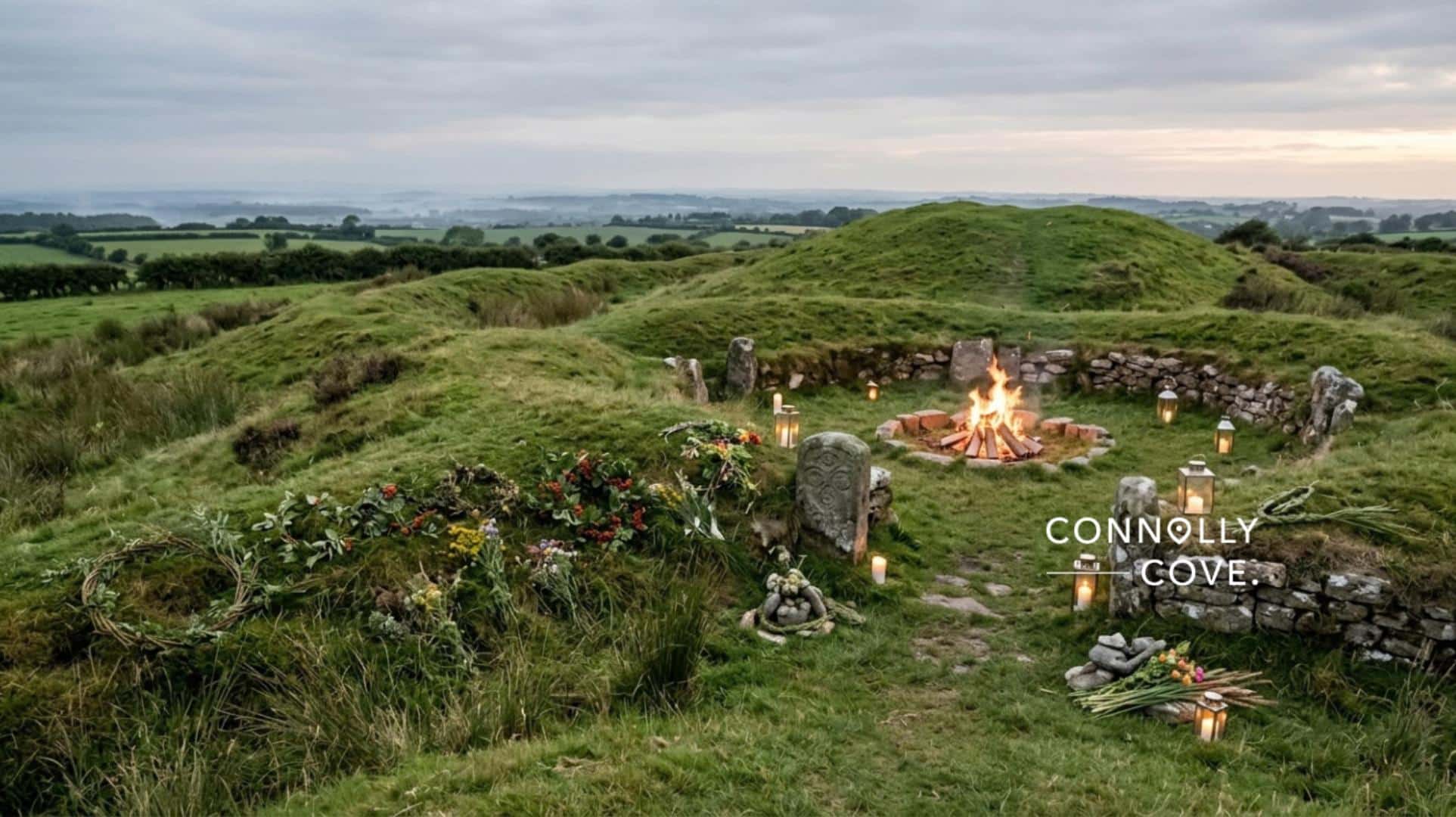
In the Dindshenchas, Sinann is drowned by the Well of Segais and gives her name to the River Shannon, and Bóand meets the same fate at the well that becomes the River Boyne. At Lough Neagh, a spring left uncovered floods a household and a city, and Eochaid’s daughter Liban is transformed. Our guide to Lough Neagh’s mystical origins covers that legend in detail, and the folklore of Irish rivers and lakes traces the same pattern across other waterways.
The Irish version of the flood is not a global judgement. It is a warning about disturbing something sacred, and the water that results is still there to be visited.
The Science Behind Flood Legends
Geology cannot verify a legend, but it can establish whether a described event was possible. The end of the last glacial period involved sea-level rise of roughly 120 metres, tsunamis, and the collapse of ice-dammed lakes, all within the span of human occupation and oral memory. Several specific hypotheses connect these events to flood legends, with varying levels of support.
The Black Sea deluge hypothesis
In 1997, marine geologists William Ryan and Walter Pitman proposed that the Mediterranean broke through the Bosphorus and flooded a freshwater lake basin, rapidly creating the Black Sea and displacing the people who farmed its shores. The hypothesis was widely publicised as a possible origin for Near Eastern flood legends. Later work has disputed both the speed and the scale of the breach, so it remains contested rather than established.
Meltwater pulses at the end of the Ice Age
Sea level did not rise smoothly. It rose in bursts, and the periods known as meltwater pulses raised global sea level by metres within a few centuries. For coastal communities, that meant losing familiar ground within living memory, repeatedly, over generations. This is the most plausible general explanation for why so many coastal cultures independently tell flood legends.
The Storegga tsunami
Around eight thousand years ago, an enormous submarine landslide off the Norwegian coast, the Storegga Slide, sent a tsunami across the North Sea. Deposits from it have been identified in Scotland, eastern England and Norway. It struck a Doggerland already reduced by rising seas. Anyone who survived it had a genuine deluge story to tell.
Can oral memory really last thousands of years?
For a long time the assumption was that oral tradition degrades within several centuries. Research comparing Aboriginal Australian stories of drowned coastline with bathymetric mapping has challenged that, finding accounts that appear to describe shorelines submerged thousands of years ago. If that holds, some flood legends are not allegory at all. They are the oldest surviving eyewitness reporting in existence.
What Flood Legends Say About Judgement, Animals and Survival
Beyond geology, flood legends are moral documents, and comparing what they choose to condemn is one of the most useful things you can do with them. The water is constant across traditions. The reason for the water is not, and that reason tells you what each society feared most about itself.
Judgement and renewal
In the Genesis and Greek accounts, human wickedness brings the flood, and the survivor is chosen for righteousness. In the Mesopotamian accounts the gods are variously disturbed, angered or simply decided, and the survivor is warned by one sympathetic deity acting against the others. In the Irish well stories, the offence is not wickedness at all but trespass against something sacred. Flood legends that punish sin produce covenants. Flood legends that punish trespass produce place names.
Animals, vessels and the survivor
The animals in flood legends are rarely decorative. They carry continuity, and in several traditions they carry information: the released birds in the Mesopotamian and Genesis accounts, the fish that warns Manu, the dove and the raven. The survivor, meanwhile, becomes an ancestor. Noah, Utnapishtim, Manu, Deucalion and Tata all found a renewed line, which is why flood legends so often sit at the start of a genealogy rather than in the middle of a story.
Related Irish and Celtic Traditions
Celtic mythology shares more with the world’s flood legends than it first appears, though the resemblance is structural rather than borrowed. Where Mesopotamian tradition uses water to end a world, Irish tradition uses water to open a boundary, and the same lakes and rivers that drown cities also carry souls into the Otherworld.
Mythological connections
Water in Irish folklore is a threshold rather than a weapon. Wells, rivers and loughs mark the edge between this world and the Otherworld, which is why disturbing them has such disproportionate consequences in the stories. The gods and goddesses associated with these waters, including Bóand and Sinann, belong to the same mythological family as the Tuatha Dé Danann, and the beings that inhabit them appear in our guide to legendary creatures of Celtic mythology. For the wider divine cast, see our guide to the Celtic gods and goddesses of ancient Ireland.
Where to experience these stories
Ireland lets you stand in the places these flood legends describe. Lough Neagh in County Antrim is the drowned city of the Liban story and the largest lake in the British Isles. The Boyne Valley in County Meath, with the Neolithic monuments at Brú na Bóinne, is Bóand’s river. The Shannon can be followed from its source in the Cuilcagh mountains, where the Shannon Pot marks the traditional site of Sinann’s well. At low tide on the Welsh coast at Borth, submerged forest stumps associated with Cantre’r Gwaelod are visible from the beach.
Cultural curiosity beyond borders
“Every culture’s flood story is really a story about its own coastline. Comparing them taught us to look at Irish loughs differently, because once you know the pattern, you start noticing how many Irish place names are just flood legends worn down into geography.” , Ciaran Connolly, Founder of ConnollyCove
FAQs
How many flood legends are there worldwide?
Several hundred have been catalogued, drawn from every inhabited continent. The commonly cited figure of over 200 comes from comparative folklore collections rather than a definitive count.
Which flood legend is the oldest?
The Mesopotamian accounts are the oldest in written form. Sumerian and Babylonian flood tablets predate the written Genesis narrative by roughly a thousand years.
Do flood legends prove a single global flood?
No. Geologists find no evidence of one worldwide flood, but strong evidence of many severe regional floods and a 120-metre sea-level rise at the end of the last glacial period.
Does Ireland have a flood legend?
Yes. Irish tradition includes Cesair arriving before the biblical Deluge, and older well-overflow stories that explain Lough Neagh, the River Shannon and the River Boyne.
Who was the Egyptian god of floods?
Hapi, god of the annual Nile inundation. The Egyptian flood was welcomed, since it deposited the silt that made farming along the river possible.
What is Doggerland?
A now-submerged landmass that once joined Britain to mainland Europe. Rising seas drowned it during the Mesolithic period, and its tools and bones are still dredged from the North Sea.
What do flood legends have in common?
Most include divine anger or disturbance, a warned survivor, a refuge, rescued animals, a landing on high ground, and a sign that the waters will not return.
Can oral traditions remember real floods?
Research on Aboriginal Australian coastal stories suggests some oral traditions have preserved accurate detail about shorelines submerged thousands of years ago.