

Article Summary
Churchill War Rooms is the underground headquarters beneath Westminster where Winston Churchill and his staff directed Britain’s Second World War effort, now a museum run by Imperial War Museums.
What this article covers: The history of the Cabinet War Rooms, the rooms worth seeing, the Churchill Museum and practical advice for planning a visit in central London.
Who this is for: Travellers planning a London trip, history readers and anyone curious about how Britain was governed during the Blitz.
Key takeaway: Book a timed slot and allow at least two hours, and the visit makes most sense when you look past Churchill to the staff who lived and worked below ground.
Expert insight: “Most people come to see Churchill’s chair, but the detail that stays with me is Wing Commander Heagerty’s three sugar cubes in the Map Room drawer. A week’s ration, carefully shaved, tells you more about wartime London than any speech on the walls,” Ciaran Connolly, Founder of ConnollyCove
Quick facts:
- The Cabinet War Rooms became fully operational one week before Britain declared war on Germany in September 1939.
- Churchill’s War Cabinet held 115 meetings in the underground rooms during the war.
- The lights in the Map Room were switched off on 16 August 1945 for the first time in six years.
Churchill War Rooms sit just below street level on King Charles Street in Westminster, in the same basement offices where Winston Churchill’s government planned much of the Second World War. When the war ended, staff switched off the lights and walked out, leaving maps, telephones and even a desk drawer of rationed sugar exactly where they were.
This ConnollyCove guide covers the history of the bunker, what to look for inside and how to plan your time, with a short walk through Westminster for when you come back up into daylight. ConnollyCove is an Ireland-based travel and culture platform, so we also follow the Irish thread in Churchill’s story that most London guides leave out.
Table of Contents
The History of the Cabinet War Rooms Beneath Westminster
The Cabinet War Rooms were converted from basement storage offices beneath the New Public Offices on Whitehall in 1938 and 1939, and they were operational a week before war was declared on 3 September 1939. The building was chosen for its strong steel frame and its position close to the Houses of Parliament, only a few minutes away on foot.
Churchill became Prime Minister in May 1940. On visiting the Cabinet Room that month, he declared it the room from which he would direct the war. The War Cabinet met underground regularly through the Blitz and again from June 1944 until March 1945, when V1 and V2 rockets were falling on London.
The Map Room was staffed day and night until shortly after Japan surrendered. After that, the rooms were left largely as they were for decades. Imperial War Museums opened them to the public in 1984, added the Churchill Museum in 2005 and renamed the whole site Churchill War Rooms in 2010.
What to See Inside the Cabinet War Rooms
The highlights are the Cabinet Room, the Map Room, the Transatlantic Telephone Room and Churchill’s bedroom, all on a one-way route with a multimedia guide included in your ticket.
The Cabinet Room
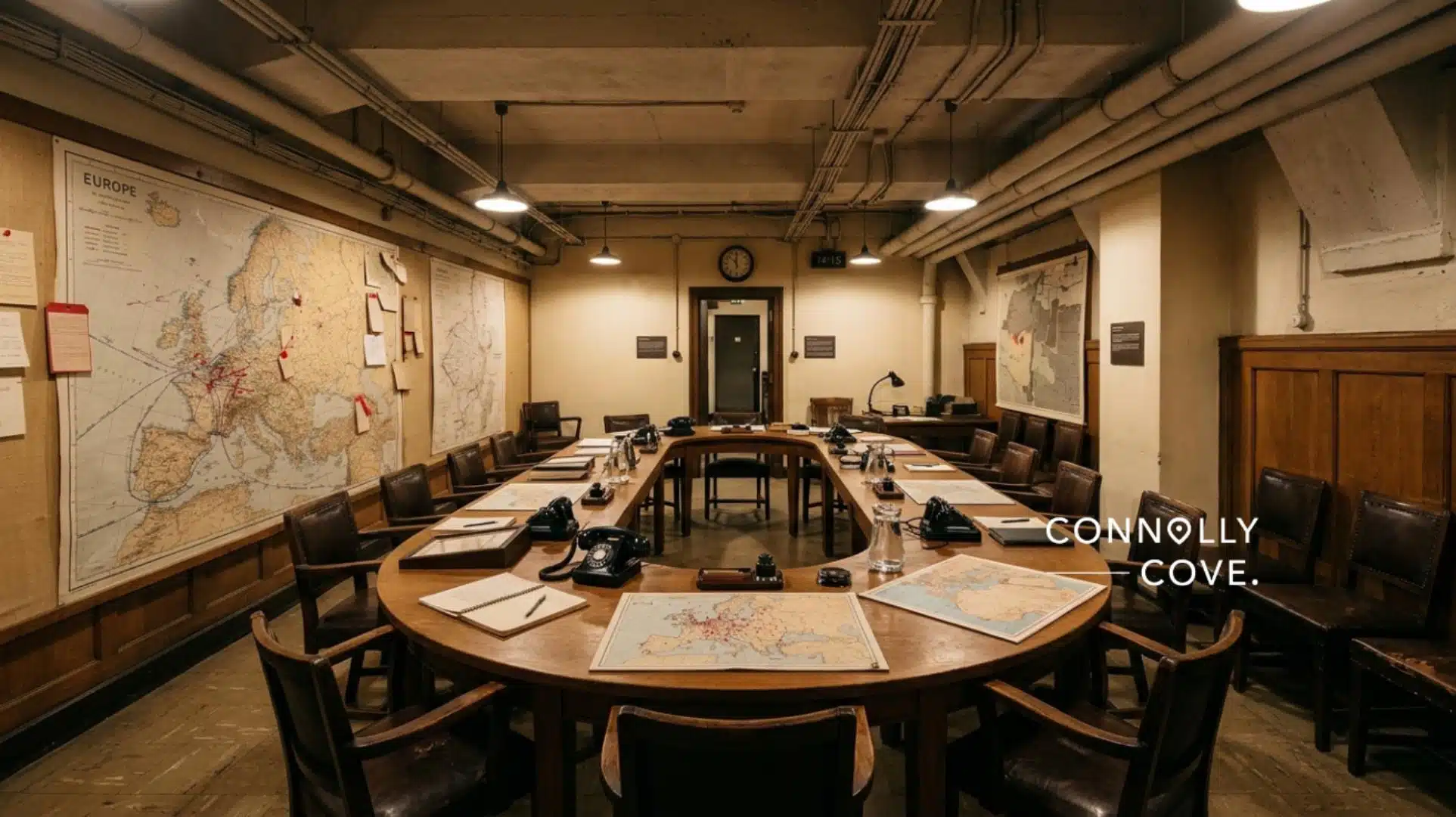
The Cabinet Room is set out as it was before a meeting on 15 October 1940, with Churchill’s chair at the centre of the table. Look closely at the wooden arms of his chair, which carry marks often put down to his restless fingers during long meetings.
The Map Room and the Sugar Cubes
The Map Room is the most complete room in the complex, with its original maps, telephones and wall charts left in place. The Atlantic convoy map is covered in pinholes, each one a position plotted by the officers who worked here.
In one desk drawer, Imperial War Museums staff found an envelope holding three sugar cubes in the early 1980s. They belonged to Wing Commander John Heagerty, and one cube has been shaved down, as if he was rationing his own ration.
The Transatlantic Telephone Room and Churchill’s Bedroom
A small door marked as Churchill’s private toilet hid a secure telephone line to the American President, scrambled through a system called SIGSALY. Churchill’s bedroom is nearby, although he rarely slept underground. He did make four wartime broadcasts from the desk in this room. If you enjoy military history on this scale, the tank museums in England make a good companion trip.
Life in the Dock and How Safe the Bunker Really Was
The bunker was never truly bomb-proof, and secrecy was its main protection. In December 1940, engineers added a reinforced concrete layer known as the Slab, up to three metres thick in places. According to Imperial War Museums, a bomb larger than 500 pounds could still have broken through and destroyed the rooms.
Junior staff carried the heaviest burden. During the Blitz, many typists, clerks and Royal Marine guards slept between shifts in a cramped sub-basement known as the Dock. With no daylight for days at a time, staff were given portable sunlamps to make up for the missing sun. The war reshaped ordinary British life far beyond Whitehall, a theme Connolly Cove explores in its look at World War II’s impact on art and culture.
Churchill’s Irish Connections
Churchill’s earliest memories were of Ireland. From about 1877 to 1880, he lived at the Little Lodge in Dublin’s Phoenix Park, now called Ratra House, while his father worked as secretary to his grandfather, the Lord Lieutenant. In his autobiography, Churchill described these years as the start of his memory. You can still walk the same ground in Phoenix Park in Dublin.
Ireland also appears in the wartime story told underground. Éire stayed neutral under Éamon de Valera. Churchill had opposed the 1938 return of the Treaty Ports to Irish control, a grievance he carried through the Atlantic convoy battles tracked on the Map Room walls. When German bombers struck Belfast in April and May 1941, de Valera sent fire crews north from Dublin and other towns to help.
HMS Belfast, now another Imperial War Museums site on the Thames, was built by Harland and Wolff, the shipyard behind Titanic. It was launched on St Patrick’s Day in 1938. The Titanic Museum in Belfast tells more of that shipbuilding story.
Planning Your Visit: Tickets, Timing and Seasons
Book a timed ticket online through Imperial War Museums and allow at least two hours. The site is generally open daily from 9.30 am to 6 pm with last entry at 5 pm, and adult tickets cost from about £34 at the time of writing, so check the official page before you travel.
The entrance is at Clive Steps, King Charles Street, London SW1A 2AQ. Westminster and St James’s Park stations are both a short walk away. A lift links street level to the basement, although corridors are narrow in places and the low lighting can feel close if you are prone to claustrophobia.
Pace yourself, because the ticket covers two different visits. The bunker comes first, and the Churchill Museum follows with its long interactive Lifeline table charting his life. Many visitors tire before reaching the museum, so a short break at the café between the two halves helps. If London is part of a longer trip, our four-day London itinerary shows where the War Rooms fit, and these tips on how to visit a museum apply well here.
Summer, from June to August, brings the busiest slots and sometimes earlier opening times. Late afternoons and weekday mornings outside school holidays are usually calmer.
Churchill War Rooms or IWM London: Which to Choose
Both are run by Imperial War Museums, but they are very different visits. IWM London in Lambeth is free and covers conflict from the First World War to the present day. Churchill War Rooms is a paid, single-building experience focused on one war and one government.
If your budget is tight, IWM London sits comfortably alongside other free things to do in London. If you want to stand in the rooms where decisions were made, the War Rooms are worth the ticket.
A Short Westminster Walk Before or After Your Visit
Everything worth pairing with the War Rooms is within roughly ten minutes on foot. From Clive Steps, walk to Horse Guards Parade and then into St James’s Park, where the lake makes a quiet break after time underground.
Return along Whitehall past the Cenotaph and the gates of Downing Street, then finish at Parliament Square, where Churchill’s statue faces the Palace of Westminster. Westminster Abbey stands across the square if you have time left in the day.
Explore More of London’s Wartime History
ConnollyCove covers travel destinations and cultural stories from Ireland, Britain and further afield. For more video guides, visit the ConnollyCove YouTube channel.
FAQs About the Churchill War Rooms
These are the questions travellers ask most often when planning a visit to the Churchill War Rooms in London. Each answer is kept short so you can plan quickly.
How long do you need at the Churchill War Rooms?
Allow at least two hours. Add more time if you want to read everything in the Churchill Museum.
Do you need to book Churchill War Rooms tickets in advance?
Yes, entry is by timed slot. Summer slots often sell out early.
Is the Churchill War Rooms part of the Imperial War Museum?
Yes, it is one of the Imperial War Museums’ sites. It is a separate paid attraction from the free IWM London in Lambeth.
Is the Churchill War Rooms wheelchair accessible?
Yes, a lift connects street level to the basement. Some corridors are narrow, so quieter times are easier.