


How to Get Around in Cairo: Your Guide to Understanding All the City’s Modes of Transportation
Updated On: April 15, 2024 by  Noha Basiouny
It is unknown what view the Fatimid had in mind when they first established Cairo in 969 CE. However this turns out to be, and no matter how wild their imagination was, there is no way they could have imagined the new capital they built has become the largest and most prominent city not just in Egypt but in the entire Middle East and Africa as well.
Cairo, or al-Qahirah as it is called in Arabic, is as exceptionally fascinating as it is painfully exhausting. This is a trait that makes it so aptly named, for Cairo translates to the subjugator, which we will know in what way it is so in just a bit! That aside, Cairo has everything a capital city may need. It is Egypt’s most centralised city, full of rich history, diverse culture, art, scenery, great architecture and modernity.
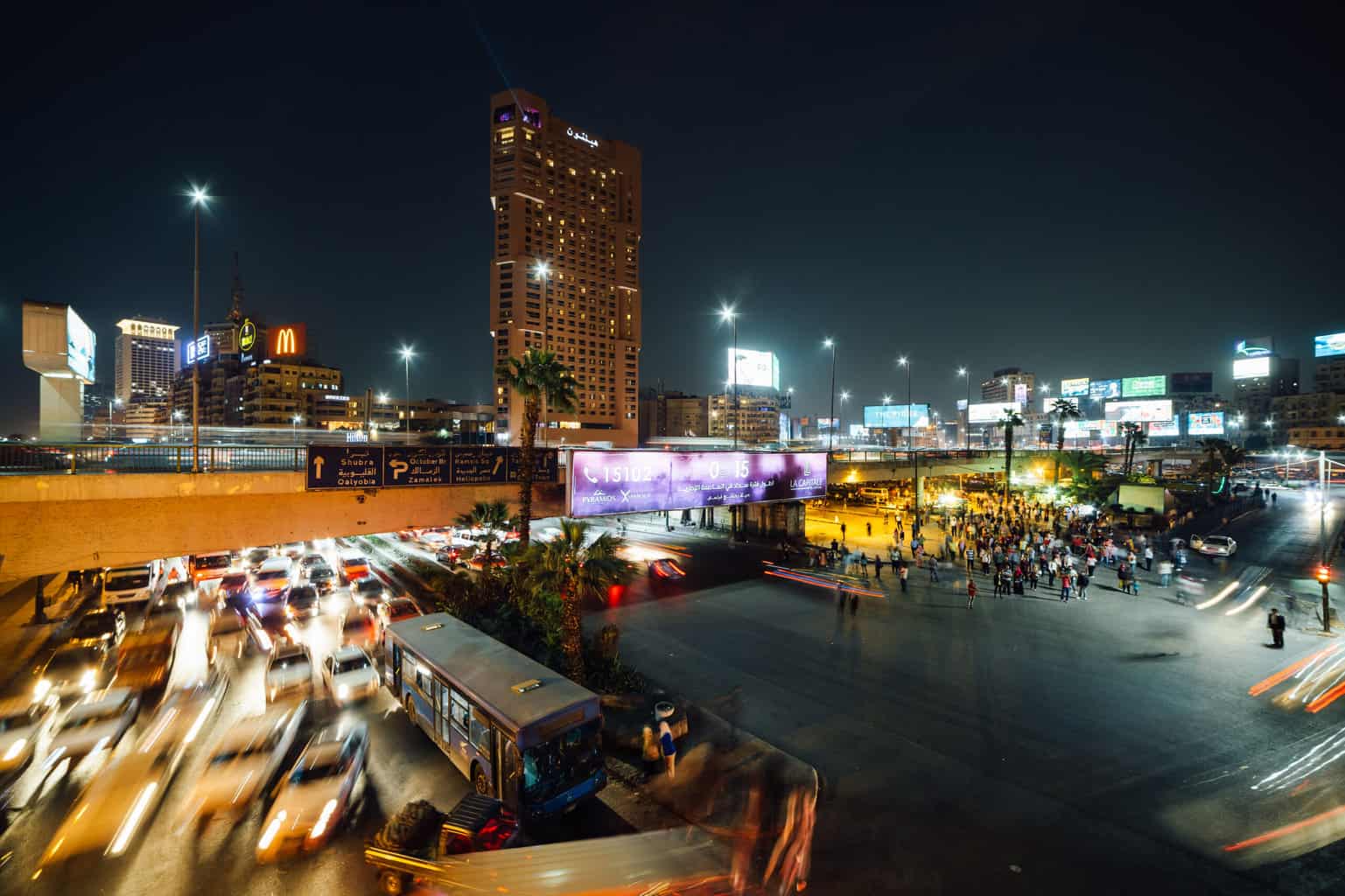
But anyone who has ever come to Cairo, as well as the city’s millions of residents, can agree that it can get a little, well, sometimes a lot, chaotic in Cairo. There seems to be a constant flood of buses, microbuses, and cars of all brands, sizes, colours, and designs, as well as bikes and motorbikes, all going back and forth between all corners of the city. This, therefore, makes going around Cairo, and let’s stay positive here, more like an adventure than just moving from one place to another.
But we have got you covered. In this article, we are going to demonstrate the different types of transportation you can use to get around Cairo, despite how much like Delhi the city may look like. But before we dive into that, we first need to learn a thing or two about Cairo.
Understanding Cairo
Cairo seems to have broken all the records when it comes to what exactly makes it the capital. Whether it is the size of the city we are talking about, the population, the roads, bridges, tunnels, businesses, attractions or the incredible number of vehicles running from here to there nonstop, they all seem to have crossed the threshold of what is normal.

So let’s break down some of these characteristics to have a better view of Cairo.
Area
The area of Cairo is, in fact, quite complicated. As defined by the geography of Egypt, Cairo, as in the governorate, is about 453 square kilometres in area. But almost no one in Egypt thinks of Cairo as being just this big, unless when it comes to filling out university admission applications or getting national IDs or driving licences.
In a much bigger context, when Egyptians say Cairo, they rather mean Greater Cairo, which spreads over an area of 3,085 square kilometres, adding in two more governorates, Giza, and al-Qalibubia, located west and north of the city, respectively.
This remained the definition of Cairo until sometime in the 1990s. But when new cities on the outskirt of Cairo started to emerge, such as New Cairo, Obour City, Shorouk City, al-Rehab, Madinaty, Sheikh Zayed City and Six of October City, the definition of Greater Cairo expanded even more to include all of these.
Just like the universe, Cairo is constantly expanding, as if it is going to take over the entire country. In fact, Egyptians rarely refer to Cairo as Cairo, but rather, they say Egypt. When someone is travelling from the south, for instance, to the capital, they usually say, “I am heading to Egypt!”
Population
Speaking of population, over 22 million people live in Cairo, making it among the top ten most populated cities in the world. The population has been increasing at a considerably fast pace over the past few decades, mainly due to the consistent migration from rural areas to the city, where people seek better work and living conditions.
But let’s face it. With such continuous growth, the city is rather exploding. Just like it is full of an annoyingly large number of attractions, it is full of people, vehicles, cats, and thousands of roller skaters who have suddenly flooded the streets over the past few years. Consequently, moving around the city has become even more hectic for either a visitor coming from elsewhere or a resident.
Road development
Despite the chaos, the Egyptian government has always kept an eye on the continuous growth of Cairo’s population and its consequences on traffic. As a way to better handle this issue, Egypt has been building more roads, the most important of which are around the city, to facilitate getting in, around, and out of it.
In addition, and over the past few years especially, Egypt has built tens of new major roads and hundreds of bridges to provide some traffic relief and reduce congestion.
Now that you can, hopefully, picture what Cairo looks like, let’s move on to the different types of transportation you can use to go around it.
Cairo’s Transport
Understanding the different means of transportation operating in Cairo will help you decide which is the best for you based on how far your destination is and how much time you have, and the money you are willing to spend. That is, for sure, if you would like to get this close to the city instead of just being on a guided tour taking you from here to there in air-conditioned buses.
Metro
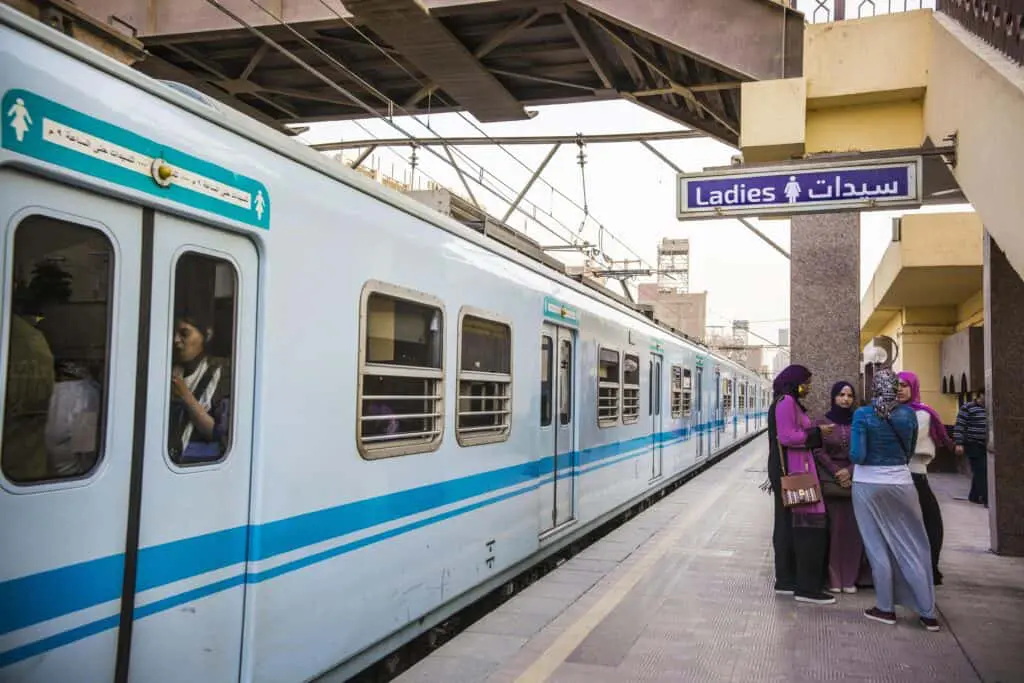
The Cairo metro, by far, has been the fastest and most prominent type of transportation in the capital city ever since it started operating in September 1987. It is the first-developed rapid transit system in Africa and the Middle East and covers a total distance of 85.4 kilometres. As Cairo grows, integrating smart mobility solutions like intelligent transportation systems, real-time tracking, and optimized routing could help improve the metro’s efficiency and coverage. Implementing innovative smart mobility solutions alongside the expansion of the existing metro system can help ensure it remains one of the best and most advanced public transportation networks in the region.
The Cairo metro comprises three lines. The first is the blue Helwan-Marg line, which was opened in 1987. It extends for 44.3 kilometres and has 35 stations. The journey from one station to another takes three and a half to four minutes.
Nine years later, in 1996, the second metro line, the red one, was opened, covering a distance of 21.6 kilometres over 20 stations. Around 13 of these 21 kilometres are above the ground. The trains on this line are faster, moving between two stations in a maximum of three minutes. This line also goes under the River Nile, crossing the island of Zamalek, and goes all the way to Giza.
The third line, the green one, was opened in 2011, last expanded in 2022 and is expected to be complete in 2024. It currently stretches over 19.5 kilometres with 23 stations. As the construction work is still ongoing, this line is yet to be expanded even more to 50 kilometres, becoming the longest of the three.
These three lines cover most of Cairo and make it super easy to reach some of the most famous attractions, such as Tahrir Square, the Egyptian Museum, which is also in Tahrir Square, Abdeen Palace, the National Museum of Egyptian Civilisation, Cairo Opera House, Downtown Cairo, and Old Cairo, along with so many other ones.
Interestingly, the three metro lines are not totally independent from one another but are connected through transitioning stations. Line One has three transitioning stations, al-Shohadaa, Nasser, and Sadat, connecting it with Lines Two and Three. Likewise, Line Two is connected to Lines One and Three through the stations of al-Shohadaa, Attaba, Sadat, and Cairo University.
Speaking of ticket prices, they have changed over the years. For a long, long time, one metro ticket could get you anywhere for just one Egyptian Pound. Starting March 2017, ticket prices changed to be based on the number of stations they cover. The larger the number, the more expensive the ticket gets.
A maximum of nine stops costs five pounds. Oh, you are going further than that? Then take the 16-stop ticket. It costs seven pounds. Tickets for over 16 stops cost 10 pounds. To avoid the confusion, if you are taking the metro, just tell the booking clerk at the station where you are heading, and they will give you the correct ticket. The metro is better taken when you are short on time and going far away.
Public buses
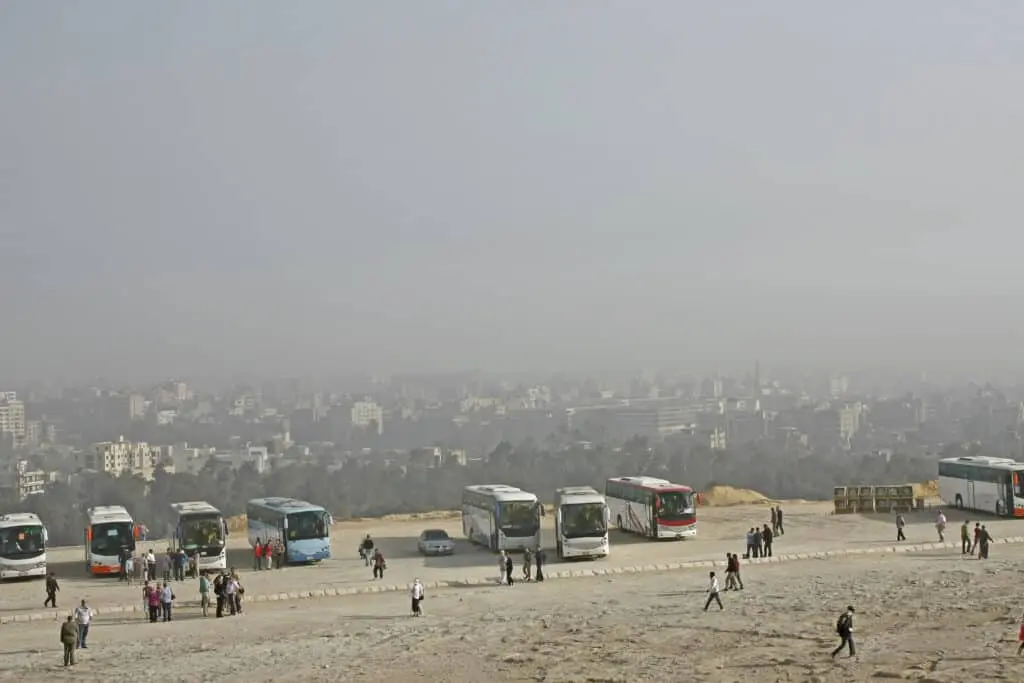
Public buses are also known as the CTA, which is rather the name of the operating company, the Cairo Transport Authority, that is also in charge of the mass transit in Cairo.
So the CTA provides buses that cover even larger areas than the metro, for they have lines in distant places in Cairo as well as the new cities, which are, geographically speaking, outside of the Cairo governorate.
Public buses are pretty affordable compared to the long distances they travel. There are over 3,000 buses that connect Cairo from east to west. They operate from 6:00 in the morning until 11:00 pm, with each line having a certain number of stops and certain appointments for departure and arrival.
This public bus is nicknamed the people’s bus. It is known for always being crowded. In addition, the public bus usually takes longer, especially from 1:00 pm up to 6:00 pm, as it often gets stuck in traffic since it travels inside the city, and this is when streets get unbelievably crowded.
Most public buses are not air-conditioned, but some are, and those are usually highly-priced, with tickets sometimes reaching 20 pounds. Some buses even have Wi-Fi onboard. Unlike the metro, a bus ticket costs the same amount regardless of the distance, mostly ranging between five to 15 pounds.
You can take the bus if you are going a very long distance, not willing to switch between or spend more on different types of transportation to reach your destination, and have plenty of time. In this case, you can enjoy your journey by reading a book, chatting with a friend or the old lady sitting next to you, or listening to music while resting your chin on your palm and contemplating the city from the bus’s large window.
It is recommended you take the bus from the main stop to increase your odds of finding an empty seat (or even a window seat if you are wildly ambitious). The most famous bus stop in Cairo is in Abdul Moneim Ryad Square, right beside the Ramses Hilton Hotel. Buses there go to different places all around the city and even to some of the new cities we mentioned before.
Interestingly, all the public bus drivers go by the name Ashraf no matter what they are called, and no one actually knows why.
Minibuses
This is another public bus service that is operated by the Cairo Transport Authority, yet, it is owned by private companies. They are referred to as minibuses because they, yes, are smaller than the public buses. However, their lines are much longer, and they even go to further places than those reached by the public buses. Minibuses work based on a predetermined schedule and can be found at the same stops as public buses.
Besides the long distances they travel, minibuses also take different, usually longer, routes that pass by so many other places that even the public buses do not pass by. In addition, tickets are also as affordable, ranging between five and 13.5 pounds.
Microbuses
Microbuses are almost the most common type of road transportation. They belong neither to the government nor to private companies. It is actually hard to explain how they operate, but it is enough to say that they are authorised. A microbus is much smaller, with the 16-seat Toyota HiAce being the most common vehicle operating as a microbus.
Microbuses are quite affordable and faster than both the public bus and the minibus. That is mainly because a microbus only leaves the stop if it is full of passengers. Once this happens, it takes off. The driver usually takes the shortest and least crowded routes to get to the destination as fast as possible. Less time means more journeys back and forth, which in turn translates to more profit.
Fares are variable according to the distance, but they are affordable anyways. Microbuses can be found in different places all around the city. Sometimes they share the same stops with the public buses. Other times, they have their very own stops.
Taxis
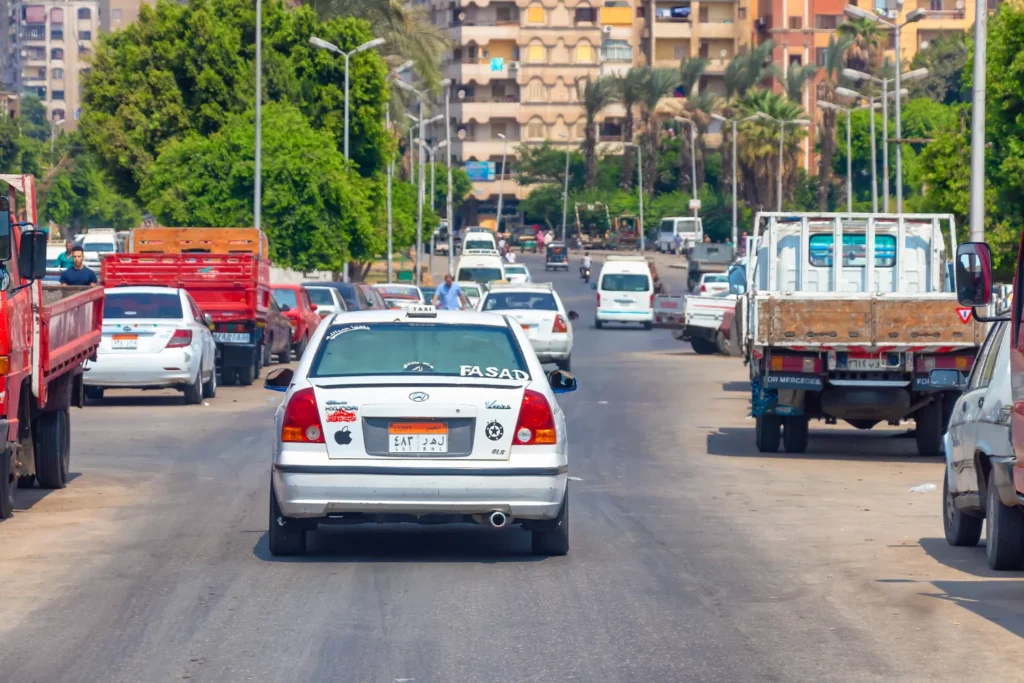
Taxis have been operating in Egypt for so long, with each governorate having a differently coloured taxi. Speaking of Cairo, taxis used to be primarily black with some white parts. However, during the past 15 years, and for some reason, taxis started to change colour, becoming completely white with just a black and white ribbon that looks like a chess board.
Taxis are found everywhere in Cairo. They are more expensive than the other types we have discussed so far since they provide faster and more private trips. They work with a counter, a taximeter, adjusted to calculate the total fare based on the number of kilometres of the trip. This cost is typically determined by the government and is influenced by gas and oil prices.
Most taxis run on natural gas, which is not only good for the environment as it reduces pollution, but it is also much cheaper than oil, which can be incredibly costly when it comes to driving to distant places in Greater Cairo.
Uber

The US-based company, Uber, started operating in Cairo in 2014, providing a new, more secure, more private and overall better transport service. But everything comes at a price, and Uber is the most highly-priced transport type in Cairo.
It works almost the same way as it does in all other countries. Through the Uber app, you can request a ride and choose the car and fare from a variety of options. In addition, Uber Scooter and Uber Shuttle are also available in Cairo.
Throughout the years, Uber has become more trusted, and many people are switching to it despite the relatively expensive fare. Even white taxi drivers are becoming captains and switching to Uber. This does not just provide them with a higher income but also with a better working experience thanks to the rules the Uber company has set.
After Uber operated in Egypt for a few years, many similar private transport companies started to get to the market and provide the same service but maybe with little differences, most notably, being less expensive than Uber.
The most famous of such companies are In-drive and Didi, with the latter providing some features not offered by Uber, such as determining the fare beforehand and letting the driver accept or reject it.
Despite its enormous size and super large population, going around Cairo is still manageable once you understand how the city operates and the different types of transportation available in it.
Every type of transportation in Cairo can provide you with a different service based on how far your destination is, how much time you have, and which fare you can afford. Long distance but little time? Take the metro. Longer distance and plenty of time? Take a bus or a minibus. Much longer distance, but you are so short on time? There is a microbus waiting for you over there; hop on it. Or do you need a more convenient way, regardless of the money? Then request your Uber ride.
4 commments on “How to Get Around in Cairo: Your Guide to Understanding All the City’s Modes of Transportation”

Exploring the Rich Tradition of Gaelic Festivals: Samhain, Imbolc, Bealtaine, and Lughnasadh
Festivals and Events
16/04/2024

Legendary Irish Golfers: A Celebration of the Emerald Isle’s Champions
Culture Exploration
16/04/2024

Westminster Pier – London Attractions
England
16/04/2024

Exploring the Ancient Meaning and Symbolism of Ailm: Strength and Endurance in Celtic Culture
Mythology and Folklore
16/04/2024

The Brandy Alexander Cocktail
Culture Exploration
16/04/2024
I am extremely satisfied with this content.
Thank you, Alex.
Glad you found the blog informative
I don’t know who wrote this article, but dead sure she or he is an Egyptian. Hoped that it would have given the non-Egyptian readers a glimpse of the history of transportation methods in Cairo. All-in-all, it is an amazing and comprehensive reference.
Glad you enjoyed the blog and found it informative 🙂