

What this article covers: A practical guide to things to do in Ballycastle, County Antrim. It runs from the beach, Bonamargy Friary and the Rathlin ferry to Fair Head, the Auld Lammas Fair and Causeway Coast day trips.
Who this is for: Travellers planning a stay on Northern Ireland’s north coast, walkers, and visitors with Irish or Scottish roots who want the history and folklore behind the views.
Key takeaway: Ballycastle works best as a base, not a stop. Give the town, its headlands and Rathlin a day each, and treat the Giant’s Causeway as the day trip.
Expert insight: “Stand at the eastern end of Ballycastle beach on a clear evening and you get Rathlin, Fair Head and the Mull of Kintyre in one sweep. That stretch of water is Sruth na Maoile, the Sea of Moyle, where the Children of Lir spent their second three hundred years as swans. I’ve watched people photograph it for thirty seconds and walk back to the car. Give it twenty minutes and the tide, the light and the story start to line up.” , Ciaran Connolly, Founder of ConnollyCove
Quick facts:
- Ballycastle’s Irish name is Baile an Chaistil, “town of the castle”, and the town had a population of 5,628 at the 2021 census.
- The Auld Lammas Fair runs on the last Monday and Tuesday of August, matching a fair day granted in a 1606 charter to Randal MacDonnell.
- In the summer of 1898, Marconi’s assistants George Kemp and Edward Glanville sent wireless signals between Ballycastle and Rathlin’s East Lighthouse for Lloyd’s of London.
Table of Contents
Ballycastle is a seaside town on the north-east coast of County Antrim, Northern Ireland, where two of the nine Glens of Antrim run down to the sea. Rathlin Island sits about six miles offshore, with Scotland’s Mull of Kintyre on the horizon behind it.
Most visitors pass straight through on the way to the Giant’s Causeway, and they miss a lot. The most rewarding things to do in Ballycastle sit within a few miles of the town centre. There’s a beach facing the Sea of Moyle, a Franciscan friary with a clan burial vault, and a harbour where wireless telegraphy was tested in 1898.
ConnollyCove is an Ireland-based travel and culture platform, and the north Antrim coast is one of the stretches we film most often. This guide separates what you can walk to from what needs a car, and it’s frank about the steps, the bogs and the weather.
Things to Do in Ballycastle Town and Harbour
You can cover most things to do in Ballycastle town on foot in a single day. The seafront, the harbour, Bonamargy Friary and the museum on Castle Street all sit within about a mile of each other. The pubs are closer still, which helps when the rain comes in sideways.
Walk Ballycastle Beach and Look Out Over the Sea of Moyle
Start with the strand, which runs east from the harbour towards the mouth of the Margy. The walk out to Pans Rock and back takes under an hour at an easy pace.
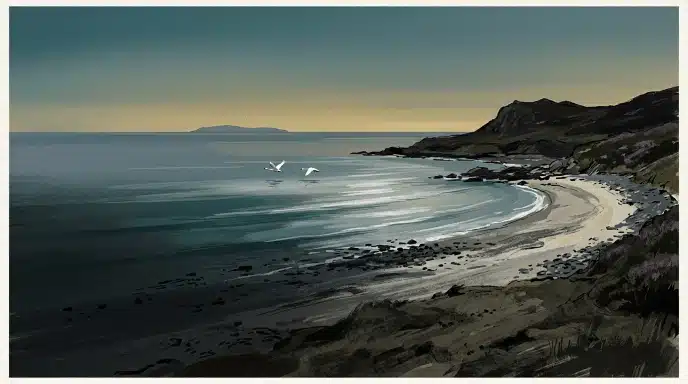
From the sand you’re looking north across Sruth na Maoile, the Sea of Moyle. This is the water at the centre of the story of the Children of Lir, told in the medieval tale Oidheadh Chlainne Lir. Their stepmother Aoife turns Lir’s four children into swans for 900 years. They spend 300 on Lough Derravaragh, 300 here on the Moyle, and 300 off Erris in County Mayo.
The Moyle years are the cruellest part of the story, full of storms and separation. When you visit on a grey day with the current running hard between the headlands, the choice of setting makes complete sense.
Step Into Clan History at Bonamargy Friary
Bonamargy Friary is a short walk east of the seafront, beside the golf course. Rory MacQuillan founded it for the Franciscans around 1500, although some sources give 1485. The rival MacDonnells later took control of the area and made the friary their burial ground.
A sealed vault holds Sorley Boy MacDonnell, the Scottish-born chieftain who held north Antrim against English and Irish rivals, along with several Earls of Antrim. At the west end of the church, a small holed stone cross is said to mark the grave of Julia MacQuillan, the “Black Nun”. This 17th-century recluse asked to be buried at the doorway so everyone entering would walk over her.
The friary is a State Care monument, open all year and free. It’s an unstaffed ruin with no exhibitions, so wear shoes that don’t mind wet grass.
Trace Marconi’s 1898 Wireless Link at the Harbour
Ballycastle has a real place in the history of radio. Between June and September 1898, Marconi’s assistant George Kemp and the engineer Edward Glanville set up a wireless link between the town and Rathlin’s East Lighthouse. The client was Lloyd’s of London, which wanted faster news of transatlantic ships passing Rathlin.
The first test signals were received on 6 July 1898, and Marconi himself visited for a few days that summer. A plaque near the ferry terminal marks the link. There’s an Irish thread too: Marconi’s mother, Annie Jameson, came from the Irish whiskey-distilling family.
Visit Ballycastle Museum on Castle Street
The museum at 59 Castle Street is small, free and worth an hour. It occupies the town’s 18th-century courthouse and market house. The star exhibit is the Taise Banner, made for the first Feis na nGleann (the Glens Feis) in 1904. It’s thought to be the only one of its set to survive.
It opens seasonally, usually from Easter to September, and closes from October to March. Check the council’s museum listing before you go, as hours have varied during restoration work.
Taste Dulse and Yellowman, Then Find a Session
Two local foods tell you exactly where you are. Dulse (Palmaria palmata) is a red seaweed gathered from the rocks and dried, and people eat it straight from the bag. Yellowman is a hard, golden honeycomb toffee made with golden syrup and bicarbonate of soda.
Both are sold at the Lammas Fair and turn up in local shops through the year. Fish and chips by the harbour is the local habit for lunch. In the evening, head to the House of McDonnell on Castle Street, a long-established family pub. It’s known for sessions of traditional Irish music, so check its social pages for session nights.
Ballycastle’s Place Names in Irish
Many names around town are anglicised Irish, and knowing the originals makes the map easier to read. Pronunciations are rough guides for English speakers.
| Place | Irish | Meaning | Rough pronunciation |
|---|---|---|---|
| Ballycastle | Baile an Chaistil | Town of the castle | BAL-yuh un KHASH-til |
| Fair Head | An Bhinn Mhór | The great headland | un vin VORE |
| Bonamargy | Bun na Mairge | Foot of the Margy | bun nuh MAR-ig-uh |
| Sea of Moyle | Sruth na Maoile | Current of the Moyle | sruh nuh MWEEL-yuh |
| Knocklayd | Cnoc Leithid | Hill of breadth | knuck LEH-hid |
| Dunaneeny | Dún an Aonaigh | Fort of the fair | doon un EE-nee |
Dunaneeny was a MacDonnell castle above the harbour, and very little of it survives. Its Irish name hints at how old the town’s fair tradition runs.
Ballycastle and Scotland: The Dál Riata Connection
Scotland is close enough here to shape the town’s story. Ballycastle Bay was once known as Port Brittas. One tradition holds that Fergus Mór mac Eirc, a king of Dál Riata, sailed from here to found a colony in Argyll.
Treat that as tradition rather than record. The later link is well documented: the MacDonnells who ruled north Antrim came from Islay and Kintyre. For visitors with Scottish or Ulster-Scots roots, the view from Fair Head across to Kintyre is part of the family history.
Coastal Walks Near Ballycastle: Fair Head, Kinbane and Murlough Bay
Walking sits near the top of most lists of things to do in Ballycastle. Fair Head lies to the east and Kinbane to the west, both free and both within 15 minutes’ drive. Neither suits flimsy shoes, and both are best avoided in strong wind.
Fair Head and Lough na Cranagh
Fair Head is the dolerite headland at the north-east corner of Ireland, with columns rising close to 200 metres above the sea. It’s a short drive east of town rather than directly above it. The land is privately farmed, and the owners maintain the paths and stiles.
Parking at the farm car park is paid in cash through an honesty box, so carry a few pound coins. Waymarked loops cross grazing land, bog and farm tracks, and the official route notes recommend walking boots. On the way you’ll pass Lough na Cranagh, where a crannóg, an artificial island dwelling of Iron Age or early medieval date, still sits in the water.
The Grey Man’s Path, a steep descent through a gap in the cliffs, is for experienced walkers only. From the top you can see Rathlin and Kintyre, and on the clearest days the Scottish islands beyond.
Kinbane Castle and the 140 Steps
Kinbane (Ceann Bán, “white head”) is a pale limestone promontory a few miles west of town. Colla MacDonnell, brother of Sorley Boy, built a two-storey castle here in 1547. English forces besieged it in 1551 and damaged it again in 1555, and Colla rebuilt it before his death in 1558.
About 140 steep steps lead down from the car park, and every one has to be climbed back up. It isn’t suitable for anyone with limited mobility, and the steps are slippery after rain.
Murlough Bay and Torr Head
East of Fair Head, a narrow road drops steeply to Murlough Bay, a quiet bay with long views across to Kintyre. Further along, Torr Head is often described as the closest point on the Irish mainland to Scotland.
Lloyd’s already had a signal station at Torr Head in 1898, and the Rathlin wireless link was built partly because ships couldn’t be reported there quickly enough. The roads are narrow and winding, so leave the caravan in town.
Ballycastle Forest and Knocklayd
When the wind is too strong for the cliffs, head inland. Ballycastle Forest covers the lower slopes of Knocklayd, the rounded hill behind the town, and its tracks give sheltered walking. The open summit is a steeper climb with wide views over the Glens.
| Walk | Approx. time | Terrain | Parking | Footwear |
|---|---|---|---|---|
| Ballycastle Beach to Pans Rock | Under 1 hour | Flat sand and shingle | Seafront pay-and-display | Trainers |
| Kinbane Castle | 30 to 45 minutes return | About 140 steep steps | Small car park at the top | Shoes with good grip |
| Fair Head loops | 1 to 2.5 hours (2.4 to 5.5 km) | Bog, grazing land, farm tracks | Farm car park, cash honesty box | Waterproof walking boots |
| Ballycastle Forest | Varies by route | Forest tracks | Forest car park | Walking shoes |
Times and distances are approximate, so check the boards at each car park before setting off.
Rathlin Island Day Trip from Ballycastle
Of all the things to do in Ballycastle, Rathlin is the one trip you shouldn’t skip. Northern Ireland’s only inhabited offshore island lies about six miles north of the harbour, with roughly 150 residents. Our guide to Rathlin Island’s history and folklore goes deeper into the island itself.
Rathlin Island puffins and the ferry from Ballycastle, filmed by ConnollyCove.
How the Rathlin Ferry Works
Rathlin Ferry runs two vessels from Ballycastle Harbour, and day visitors can’t take a car across. Book ahead from spring to September, when the first and last sailings fill up first. Every sailing is at the skipper’s discretion, so check Rathlin Ferry’s official timetable on the morning you travel.
| Vessel | Type | Crossing time | Luggage and bikes |
|---|---|---|---|
| Kintra II | Fast passenger catamaran | About 30 minutes | No luggage |
| Spirit of Rathlin | Passenger and vehicle ferry | About 40 minutes | Luggage and up to 10 bikes |
Puffins, the West Light and Bruce’s Cave
Puffins nest on the cliffs below the RSPB West Light Seabird Centre, at the island’s western tip, from around April to July. Our guide to puffins in Ireland explains how to watch them without disturbing the colonies.
The West Light is the “upside-down” lighthouse, with its lamp at the bottom of the tower. It’s a hilly six kilometres from the harbour, so take the island bus or hire a bike. Near the East Lighthouse, Bruce’s Cave is one of several places that claim Robert the Bruce took heart from a spider in 1306. Enjoy it as legend.
The Auld Lammas Fair
The Auld Lammas Fair (also spelt Ould) fills Ballycastle on the last Monday and Tuesday of August, with events the weekend before. In 1606 Randal MacDonnell obtained a charter for six fairs a year at Dunaneeny, one on the last Tuesday of August. That is the date the fair still keeps, and it’s the busiest weekend for things to do in Ballycastle.
It’s often called Ireland’s oldest traditional fair, a title other towns dispute. Around 400 stalls line the Diamond, Castle Street, Ann Street and Quay Road, and horse trading still happens on Fairhill Street. Buy dulse and yellowman while you’re there; that’s the tradition. For the fair’s history and its famous ballad, read our full guide to the Auld Lammas Fair.
Day Trips Along the Causeway Coast
Several famous north coast sights are near Ballycastle but not in it, and many lists of things to do in Ballycastle blur the two. Based in Ireland, ConnollyCove covers this coast in video and written guides. The table shows roughly how far each stop is.
| From Ballycastle to | Approx. drive | Direction |
|---|---|---|
| Kinbane Castle | 10 minutes | West |
| Fair Head | 10 to 15 minutes | East |
| Carrick-a-Rede Rope Bridge | 15 minutes | West |
| The Dark Hedges | 20 minutes | South-west |
| Giant’s Causeway | 30 minutes | West |
| Dunluce Castle | 35 to 40 minutes | West |
| Glenariff Forest Park | 35 minutes | South |
Driving times are estimates for light traffic. Summer coach traffic adds more.
Carrick-a-Rede and Ballintoy Harbour
The Carrick-a-Rede Rope Bridge crosses a gap of about 20 metres, roughly 30 metres above the sea. Salmon fishermen first strung a bridge here to reach their nets, and the National Trust now runs timed tickets. Ballintoy Harbour, a few minutes west, stood in for the Iron Islands in Game of Thrones.
Ballintoy Harbour on the Causeway Coast, filmed by ConnollyCove.
The Giant’s Causeway
The Giant’s Causeway is made up of roughly 40,000 basalt columns and became Northern Ireland’s first UNESCO World Heritage Site in 1986. Walking down to the stones is free on a public right of way. The National Trust charges for its Visitor Experience and on-site car park.
The Giant’s Causeway, filmed by ConnollyCove.
Dunluce Castle
Dunluce Castle stands on a sea cliff west of Bushmills. The MacQuillans held it before the MacDonnells took it in the 16th century under Sorley Boy, the chieftain buried at Bonamargy. Seeing both in one day makes the clan story far easier to follow.
Dunluce Castle on the Antrim coast, filmed by ConnollyCove.
The Dark Hedges and the Glens
The Dark Hedges is an avenue of beech trees on the Bregagh Road near Stranocum. The Stuart family planted it in the 18th century, and it later played the Kingsroad in Game of Thrones, so go early to beat the crowds.
South of town, the A2 coast road runs past Cushendun towards Glenariff Forest Park, the “Queen of the Glens”. Its waterfall walk makes a good half-day when the coast is busy.
How to Spend a Day in Ballycastle
If you only have one day, build it around the ferry. This plan fits the core things to do in Ballycastle into daylight hours, with Rathlin first and a short drive at the end.
Morning: Catch an early sailing to Rathlin and take the island bus to the West Light for the seabirds in season. Return on an early-afternoon boat, confirming times when you book.
Afternoon: Walk the strand to Bonamargy Friary, stop at the Marconi plaque, and fit in the museum between Easter and September.
Evening: Drive ten minutes west to Kinbane for the late light over Rathlin, if your knees are up to 140 steps. Finish with fish and chips and a pint in town. If the ferry is cancelled, swap Rathlin for Fair Head, provided the wind has dropped.
Current Conditions and Seasonal Information
Ballycastle faces the wind off the North Channel, and the weather decides which things to do in Ballycastle work on a given day. These patterns hold from year to year; for live conditions, check the Met Office forecast and the ferry operator on the day.
When to Visit Ballycastle
Each season suits a different kind of trip. Summer brings the most activity, while winter rewards visitors who want empty beaches and don’t mind closed doors.
| Season | What’s on | What to watch for |
|---|---|---|
| Spring (March to May) | Puffins return to Rathlin from around April; the museum opens at Easter | Cold wind on the headlands |
| Summer (June to August) | Longest days, busiest ferries, Lammas Fair in late August | Book ferry seats and beds early |
| Autumn (September to November) | Quieter walks; museum usually open in September | Shorter days, wet ground at Fair Head |
| Winter (December to February) | Empty beaches and big seas | Reduced ferries, museum closed, gales |
Rainy Day Things to Do in Ballycastle
A wet day still leaves plenty of things to do in Ballycastle, although the options shrink in winter. The museum is the first stop between Easter and September, and Bonamargy is at its most atmospheric in the rain. Broughgammon Farm, a family-run farm just outside town, has a farm shop and café. After that, the obvious answer is a pub with a fire.
Getting to Ballycastle and Parking
Driving from Belfast takes roughly an hour and a quarter through Ballymena, or longer on the coast road. Translink runs buses from Ballymena and Coleraine, plus a seasonal Causeway Rambler along the coast. Pay-and-display parking is available at the harbour and fills quickly in July and August. Northern Ireland uses pounds sterling, so bring cash for honesty boxes and fair stalls.
Frequently Asked Questions
Where is Ballycastle in Northern Ireland, and what county is it in?
Ballycastle is in County Antrim, on the north-east coast of Northern Ireland. It sits at the eastern end of the Causeway Coastal Route, where the Glens of Antrim meet the sea opposite Rathlin Island. The town falls within Causeway Coast and Glens Borough Council. Don’t confuse it with the village of Ballycastle in County Mayo, in the Republic of Ireland, near the Céide Fields.
What is Ballycastle famous for?
Ballycastle is best known for the Auld Lammas Fair, held on the last Monday and Tuesday of August, and as the ferry port for Rathlin Island. It’s also known for dulse and yellowman, the headlands of Fair Head and Kinbane, and Bonamargy Friary, where Sorley Boy MacDonnell is buried. Radio historians know it for Marconi’s 1898 wireless link to Rathlin.
Is Ballycastle worth visiting?
Yes, especially if you want walking, history and folklore rather than crowds. Ballycastle is quieter than the resorts further west, with Fair Head, Kinbane and the Rathlin ferry on its doorstep. The Giant’s Causeway is around 30 minutes away by car, so the town works well as a base. Plan at least two nights to fit in Rathlin, the headlands and a day trip.
How long is the ferry from Ballycastle to Rathlin Island?
The crossing takes about 30 minutes on the fast catamaran Kintra II and about 40 minutes on the larger Spirit of Rathlin. Both sail from Ballycastle Harbour. Kintra II carries no luggage, while Spirit of Rathlin takes bikes and luggage. Book ahead from spring to September, and check the timetable on the day, because every sailing depends on the weather.
What can you do in Ballycastle when it rains?
Visit Ballycastle Museum on Castle Street between Easter and September, then walk to Bonamargy Friary, which is at its moodiest in the rain. Broughgammon Farm outside town has a farm shop and café. Ballycastle Forest gives sheltered walking on the slopes of Knocklayd. In the evening, a traditional pub with a fire and a music session is the local answer to bad weather.
When is the Auld Lammas Fair in Ballycastle?
The Auld Lammas Fair takes place on the last Monday and Tuesday of August every year, with extra events on the weekend before. Its date matches a fair day in a 1606 charter granted to Randal MacDonnell. Expect around 400 stalls through the town centre, horse trading on Fairhill Street, and plenty of dulse and yellowman. Accommodation fills early, so book months ahead.
What does Ballycastle mean in Irish?
Ballycastle comes from the Irish Baile an Chaistil, meaning “town of the castle”, roughly pronounced “BAL-yuh un KHASH-til”. Very little survives of the MacDonnell castle at Dunaneeny above the harbour. Many nearby names are also Irish in origin, including Bonamargy (Bun na Mairge, “foot of the Margy”) and Fair Head (An Bhinn Mhór, “the great headland”).
Can you visit Ballycastle without a car?
Yes. Most things to do in Ballycastle town are walkable, including the beach, Bonamargy Friary, the museum and the Rathlin ferry. Translink buses connect Ballycastle with Ballymena and Coleraine, and the seasonal Causeway Rambler runs along the coast towards Carrick-a-Rede and the Giant’s Causeway. Fair Head and Kinbane are much harder without a car or taxi.
Plan Your Visit to Ballycastle
Ballycastle rewards anyone who slows down. Spend a day in town, a day on Rathlin and a morning on Fair Head or Kinbane, then use the Causeway as your day trip. Most things to do in Ballycastle need decent footwear, cash for honesty boxes and a plan for rain.
Ciaran Connolly founded ConnollyCove to help travellers find the stories behind the places they visit, and this corner of Antrim is full of them. ConnollyCove produces in-depth guides to Irish heritage, Celtic mythology and travel across Ireland and beyond. If the Children of Lir caught your imagination, continue with our guide to creatures from Celtic mythology. Our YouTube channel has more walking footage from the Antrim coast.