


Azerbaijan: Explore 20 Fascinating Locations from Heaven
Updated On: April 17, 2024 by  Shaimaa Olwan
The Republic of Azerbaijan is one of the six independent Turkish states in the Caucasus region of Eurasia. It is situated at the crossroads of Eastern Europe and Western Asia, it oversees the Caspian Sea to the east. It is bordered by Russia to the north, shares borders with Georgia to the northwest, Armenia to the west, and Iran to the south. Its capital is the city of Baku in the Caspian Sea.
Azerbaijan is located in the South Caucasus region of Eurasia and extends over Western Asia and Eastern Europe. Three main features dominate the geography of Azerbaijan: the Caspian Sea, which forms the natural coastal boundary to the east, the Greater Caucasus Mountains to the north, and the wide plains in the center of the country.
Azerbaijan hosts three famous mountains, the Greater and Lesser Caucasus and the Talysh Mountains, which cover about 40% of its total area. The highest peak in Azerbaijan is Mount Bazarduzu. Almost half of all mud volcanoes in the world are located in Azerbaijan.
Azerbaijan is a safe country. You can travel to Azerbaijan in all seasons according to your desires. If you are a tourist loving winter and snow, the month of September will be wonderful, and if you love summer, the month of March is special in Azerbaijan. Azerbaijan is characterized by many handicrafts such as carpets, and any visitor to this country should bring a number of beautiful and handmade souvenirs.
Discover Azerbaijan
Azerbaijan is distinguished by its geographical location, which made it a wonderful mixture between East and West. This is the main reason why it is one of the most important touristic destinations around the world. It allows you to explore many attractions and have a lot of fun activities, with beautiful landscapes that attract tourists from all over the world. Visitors to Azerbaijan enjoy watching forts, palaces, museums, mud volcanoes, beautiful landscapes, and the most important touristic destinations explored in the following.
Resorts
Perhaps among the most important touristic attractions in Azerbaijan are the resorts. This is in addition to its picturesque beaches with fine sand and clear, warm water, which enjoys constant temperatures most times of the year. This allows you to enjoy swimming most months of the year.
Moreover, Azerbaijan has many interesting sports areas and winter activities, the most famous of which is Alpine climbing. It also has a variety of health and natural therapeutic resorts, which are visited by thousands of tourists in different parts of the country with the aim of treating many diseases.
Azerbaijan has a variety of entertainment facilities for tourists in terms of spectacular beaches on the Caspian Sea, local and international markets, to various restaurants that serve local and international cuisines in order to satisfy everyone’s tastes. In Azerbaijan, you will be provided with all means of comfort and modernity.
Nature
Azerbaijan also has reserves of birds and animals of various kinds. All this is in addition to the traditional crafts that characterize Azerbaijan, and its visitors are admired from all over. So, if you are looking for an exciting tourist destination, tourism in Azerbaijan is an ideal suggestion for you.
Azerbaijan is home to a wide variety of landscapes. More than half of Azerbaijan’s landmass consists of mountains and plateaus that rise to great heights, the rest of Azerbaijan’s topography consists of plains and lowlands.
The flora varies greatly in Azerbaijan, with more than 4,500 species of higher plants recorded in the country. Due to the unique climate of Azerbaijan, the plant diversity in the country is richer than in other republics of the South Caucasus. The symbol of animal life in Azerbaijan is the Karabakh horse, a mountain and steppe racehorse that is found only in Azerbaijan. The Karabakh horse has a reputation for good temper, elegance, speed, and intelligence. It is one of the oldest breeds, with its lineage dating back to the ancient world. The horse was originally developed in the Nagorno-Karabakh region of Azerbaijan.
Climate
The climate in Azerbaijan is influenced by cold, Scandinavian, temperate arctic air masses from Siberia and high atmospheric pressure from Central Asia. The country’s diverse landscape affects the distribution of air masses.
The Greater Caucasus Mountains protect the country from the direct effects of cold masses coming from the north. Which leads to the formation of a subtropical climate on most of the hills and plains of the country. Meanwhile, the plains and hills are characterized by high rates of solar radiation.
Baku, the capital of Azerbaijan on the Caspian Sea, enjoys mild weather, with an average temperature of 25 degrees Celsius in July, and dropping to 4 degrees Celsius in January. In general, the climate is continental and variable in the country’s territory, meaning that it is cold in winter, hot in summer, dry in the low-lying areas, and cold and rainy in the highlands. The weather varies slightly according to the geographical area.
Azerbaijan is famous for its natural resources, and its ancient culture, in addition to its authentic history. It is also famous for many archaeological, historical, and architectural monuments.
Architecture
Azerbaijani architecture usually combines elements of East and West. Many ancient architectural masterpieces such as the Maiden’s Tower and the Palace of the Shirvanshahs in the Walled City of Baku are still alive today. Sites inscribed on the UNESCO World Heritage List include the Gobustan Reserve, the Baku Fire Temple, the Mumin Khatun Mausoleum, and the Sheki Khanate Palace in Sheki.
Other medieval architectural treasures that reflect the influence of several schools include the Palace of the Shirvan Shahs in Baku, the Palace of the Sheki Khanate in the town of Sheki in north-central Azerbaijan, the Surakhani Temple on the Absheron Peninsula, a number of bridges spanning the Aras River, and a number of mausoleums. In the nineteenth and early twentieth centuries, a few distinguished architectures appeared, but distinguished residences were established in Baku and other regions. Among the last architectural monuments, the Baku subway is famous for its grandiose design.
Attractions in Azerbaijan
Baku
The capital of Baku is one of the most famous travel destinations in Azerbaijan, as it has many wonderful historical and religious sites, in addition to being famous for its modern architecture. The Old City of Baku is listed among the UNESCO World Heritage Sites. It contains many monuments including the Palace of the Shirvanshahs, Maiden Tower, and Gobustan National Park, which lies on the outskirts of the city and is filled with ancient rock carvings, and inhabited caves, settlements, and burial sites dating back more than 40,000 years.
Baku is the largest city in the Caucasus and the financial and commercial center in Azerbaijan. It is a city located on the coast of the Caspian Sea at the southern tip of the Absheron Peninsula. It is famous for many of the best touristic places in Baku, including its ancient walled city since the Middle Ages, which contains the palace of the Shirvanshahs, the royal complex Spacious, among the important places of tourism in Azerbaijan.
The city of Baku enjoys a moderate semi-continental climate, accompanied by the Caspian breeze most days of the year, and the tourist places in modern and ancient Baku are a huge mixture of cultures, as the country of Azerbaijan is located at the crossroads between Europe, Asia, and the Middle East, and therefore, the country was affected, and certainly its capital with all those surrounding areas.
Baku is full of touristic hotels, it is most known for its touristic attractions, such as museums, Heydar Aliyev Center, and skyscrapers, the most famous of which are flame towers and huge shopping centers.
Important Landmarks in Baku
Baku Beaches
Baku is one of the coastal cities that are characterized by distinctive beauty. The charming beaches of Baku, which are considered among the important touristic areas in Baku, offer many activities and various water sports.
Baku Museums
Baku includes more than 30 museums that contain in total many pieces that give a comprehensive view of everything related to the country, starting from its history to its present and future.
Old City of Baku
It is one of the important touristic attractions in Baku, as the old city of Baku is a vivid example of the richness of the city in terms of economic, cultural and historical terms, in addition to the wonderful view of the Caspian Sea. The history of the ancient city dates back to the Bronze Age, and this is evident in the excavations on the ancient walls.
Due to its important location on the Caspian Sea, many civilizations such as the Persian, Byzantine, and Islamic civilizations flourished in Baku, in addition to the Russian occupation that lasted for a long time. In the past, it had two gates, one for entry and the other for the exit, in addition to some watchtowers.
The old city was surrounded by an extended wall whose remains are still present until now, it was originally constructed for the purpose of protecting the city from external invasions, and inside the city, there are a large number of shrines such as Saray al-Saada, Haji Qayib Bath, Bab al-Hiba Mosque, the Baku Fire Temple, and the Shirvanshahs’ Palace, it is like an open museum.
Shirvanshahs Palace
A palace dating back to the 15th century. It was built by the rulers of Shirvan known as the Shirvanshahs. One of the architectural heritage monuments of Azerbaijan dates back to the fourteenth century. This palace was the residence of the Shirvan rulers, the ruling dynasty of northeastern Azerbaijan during the Middle Ages. Most of the palace was built during the 15th century.
Old Baku has preserved a large part of its defensive walls dating back to the 12th century CE. Among its famous edifices are the Maiden’s Castle (Quz Qala-Si), which was built in the 12th century on foundations and pillars dating back to the 6th and 7th centuries BCE, and the Palace of Shirvanshahs is considered one of the major pieces of evidence of great architecture in Azerbaijan.
One of the prominent sections of this palace is the Diwan Khana, in which the ruler used to judge and sentence the guilty to retribution. Above the southern entrance to the hall, there are inscriptions of the Holy Quran. In the southern courtyard, there is a tomb built in the second half of the 15th century, called the “Darwish Mausoleum,” in which the scholar Khalil Sayyid Yahya al-Bakawi, who was a physician, astronomy, and mathematician, was buried. One of the local legends says that the name of the city of Baku is derived from the name of the aforementioned scientist.
Heydar Aliyev Cultural Center
Heydar Aliyev Cultural Center is one of the most striking places for tourism in Baku, it is characterized by its unparalleled space architecture. Heydar Aliyev Center is one of the important landmarks of the capital, Baku. The cultural center is named after former president Heydar Aliyev, and it is one of the top attractions in Azerbaijan.
The cultural center was designed by the Iraqi female designer “Zaha Hadid” who created it in the form of a high sea wave floating on the beach, which made it a symbol Worldly famous for its unique culture and a source of inspiration to visit and enjoy from all over the world.
The center overlooks a beautiful landscape with an artificial waterfall that gives a sense of comfort and tranquility to the visitors. The building contains a conference center, in addition to a large library open for the public. The center includes several halls that display many heritage collections, especially the carpets that Azerbaijan is most famous for.
Water Park in Baku
The water park in Baku is located in the Bilge Beach Hotel, it includes several slides, water games, and water pools suitable for adults and children.
Baku Gardens
Among the most important touristic attractions in Baku are its gardens, which include ancient and modern fountains, and enjoy wonderful nature, and pedestrian paths.
Baku Zoo
Baku Zoo is one of the ancient places of tourism in Baku, as it was established in 1928. It includes more than 170 different species of animals from more than one environment in the world.
Baku Amusement Park
Baku city hosts many amusement parks, which are considered one of Baku’s distinctive tourist places, which include exciting and distinctive games suitable for adults and children, and provide unparalleled fun for visitors to the country.
Baku Malls
Baku is an important destination for shopaholics, as it includes many markets and malls that provide competitive shopping opportunities along with entertainment.
Mountain of Fire
It is located on a hill overlooking the Caspian Sea, and it is considered one of the touristic places in Baku, which attracts natural tourists. The fire was formed due to the inconsistent composition of the mountain, which made it possible for this fire to appear between the cracks in the mountain. These cracks caused gas and oil to appear also close to these cracks, and this is the secret to the continued appearance of this permanent fire. There are several ancient myths about it in Azerbaijan.
Baku Streets
Baku is characterized by a number of historical and modern streets that provide a unique opportunity for picnics and for lovers of walking and running, some famous pedestrian roads are among the important touristic places in Baku.
Baku Eye
It is a unique opportunity to take panoramic photos of the city of Baku and the Caspian Sea from above, and it is one of the places of tourism in Baku that every visitor to the city visits.
Baku Towers
Baku Towers are the tallest three skyscrapers in the city of Baku, with a height of 182 meters. The facades of the three towers act as large screens for lighting units and high-power screens. They include shopping centers, cinemas, and luxury hotels.
Maiden Tower
It is one of the important tourist attractions and one of the important landmarks in Baku located in the Old City. Tourists can reach the top of the tower to behold the Caspian Sea and other historical palaces in the region.
The tower also includes a museum that contains precious items of this historical era, in addition to many artifacts of the successive ruling families that once ruled the country. The Tower Square hosts several festivals during the celebration of Nowruz, which usually reflects nation’s culture and heritage.
Gabala
Gabala city is the oldest historical place in the country. One of the most important touristic destinations in Azerbaijan, which visitors love is Ancient Gabala.
The most striking thing in the city of Gabala is the green chestnut and walnut forests, and modern recreational facilities, such as the recreational city of Gabala. There are several wonderful waterfalls, such as the mountain Gozel waterfall, you will also find Islamic sites in which tourists spend an important time, such as the new Gabala city mosque.
Important landmarks in Gabala:
The Ancient City of Gabala
According to historical sources, the ancient city of Gabala was built in the first century CE, many different historical periods passed through it until the Islamic conquest entered it, then the Mongols occupied it, then the Ottomans, followed by the Soviet occupation of the country, and it was natural for all of them to leave some historical remains that affect the city. Hence, the historical wealth of ancient ruins, museums, and various heritage sites made it a unique destination for tourism in Azerbaijan.
After independence from the Soviet Union, many buildings were removed to introduce updated renovations and services. A green belt was made around the coasts and beaches, and many facilities were established to serve the touristic activity in the city.
Gozel Mountain Waterfall
One of the important touristic areas in Gabala, in the area of the seven waterfalls, especially the mountainous Gozel waterfall, where young and old love this wonderful atmosphere and the scenic views surrounding the waterfalls.
Those wishing to reach the top of the waterfall will find a gradual shortcut, albeit somewhat difficult, but reaching the top of the waterfall and the wonderful views that the tourist sees makes it worth it. Do not forget to take more rare photos, whether you are at the top of the waterfall or in its surroundings.
New Mosque in Gabala
Gabala Mosque is one of the important touristic attractions in the city of Gabala, which attracts interest to visit the religious landmarks in the city. The New Gabala City Mosque is the most important shrine with its distinctive architecture, wonderful design, beautiful gilded Islamic decorations that cover its halls and pillars in Quranic verses. The Arabic calligraphy with its artistic style represents the greatness and beauty of that ancient civilization.
Quba
If you love relaxation away from the noise of crowded cities and capitals, the most suitable place for this is the city of Quba, which is 180 km from Baku, located on the sides of the Caucasus Islands. It is truly a wonderful site that speaks of calm and beauty, in which there is a lot of aromas of the past and its effects that attract lovers of tourism in Azerbaijan.
Nature and recreation lovers will spend a wonderful time around Affordsey Falls, and the company of children in Nizami Park, with its kindergartens, orchards, and areas designated for children will be wonderful, while lovers of religious tourism, its monuments, and its distinctive architecture will live moments of majesty inside the Juma Mosque. It is also known as the city of craftsmen and merchants.
Important Landmarks Quba:
Afurdzhi Falls
You will be fascinated by the nature of the place, the closer you are to the site of Affordsey Falls, the clearer the sound of the water falling, which represents a wonderful and perfect atmosphere with the songbirds singing all over the place, in addition to the calmness and tranquility of the waterfall sound that emerges from water falling from the high mountains. Forests transport you to heaven on earth and fit into this wonderful divine formation to become part of this wonderful universe. You will find a small elegant station that serves you tea with jam and honey in a light meal that makes you more active and optimistic.
Nizami Park
Nizami Park is a relatively small park, but it is of great importance. It represents the best place where the people of Quba and its visitors meet. It is always the right place for holding meetings and conferences, as well as popular festivals in which young and old participate, with a beautiful architectural style.
There are many marble and bronze statues of poets and celebrities in the garden, it also includes a wonderful museum with many collectibles. Also, there are fountains, some of which date back to the 19th and early 20th centuries, in addition to sculptures and decorations that give the place a high artistic value. The park is also characterized by cafes, restaurants and various shops that satisfy shopaholics, especially local products, so those coming for tourism in Azerbaijan will spend fun times in Nizami Park.
Juma Mosque
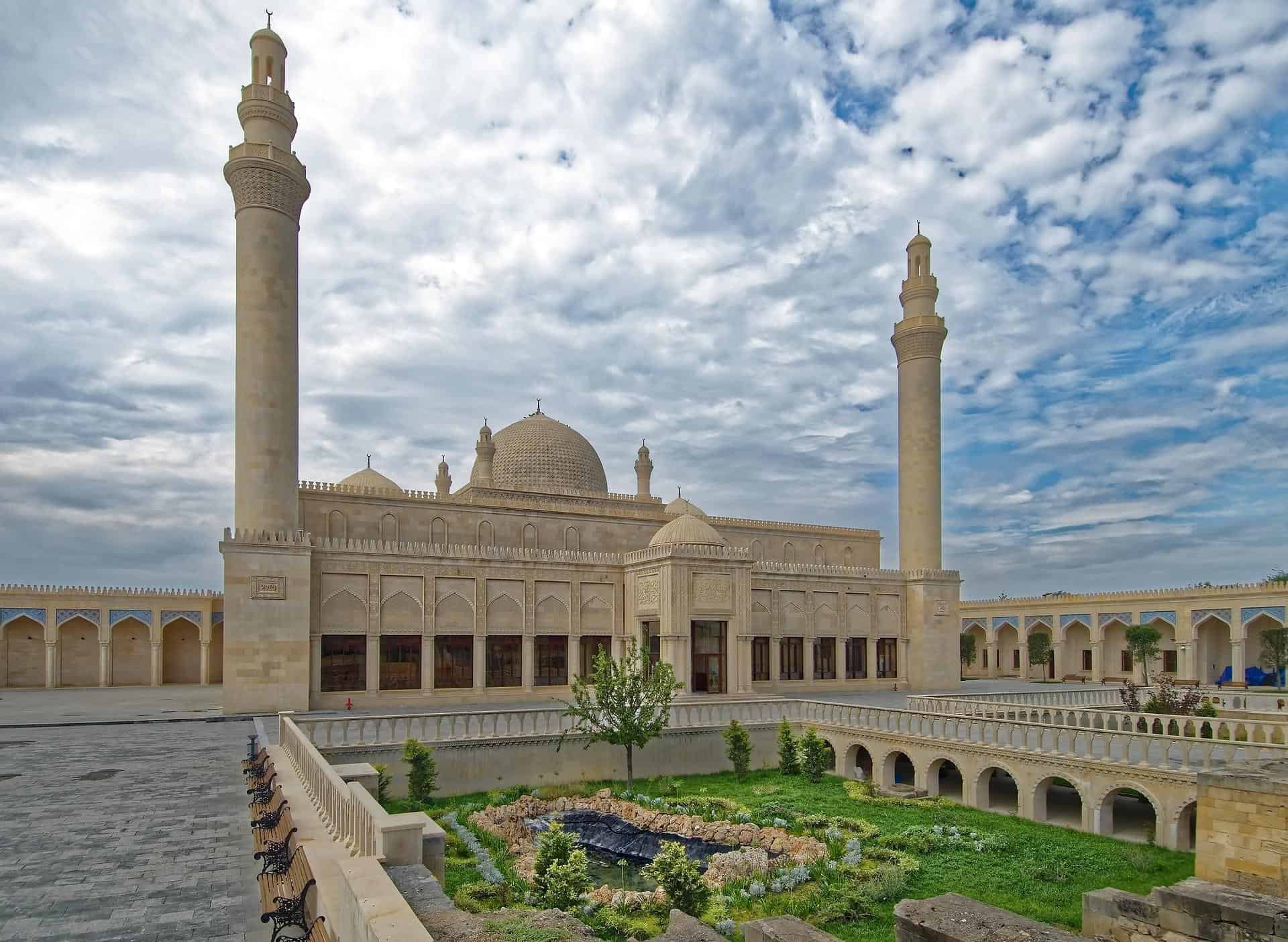
The Great Juma Mosque is an important mosque in Quba, characterized by its unique location surrounded by gardens and meadows. It is an old mosque built in the 19th century. It has a large hall on top of which is a great silver dome, and a super high minaret. The mosque is spread around the farms, pastures, and old houses, which are often at the top of the tourist attractions in Azerbaijan.
In a country where most of its residents embrace Islam, it is natural for many mosques to be present in various locations. When this country passes through many historical eras, including the Islamic era, we must expect the presence of many ancient mosques that are distinguished by high Islamic art and engineering features expressing that history.
Sheki
Ancient cities continue to bear the glare and grandeur of history as the main touristic destinations in Azerbaijan. The city of Sheki translates the intimacy of history and the authenticity of the place with its unique location on the tops of the Caucasus Mountains, with surroundings that are dominated by the wonders of nature and its irresistible charm, where pure water springs, rivers, and forests are spread, if we add to the charm of the site and nature.
The city of Sheki is located at the foot of the southern Caucasus Mountains, where the history of this city dates back to 2500 years, making it one of the oldest settlements of the Caucasus. It is famous for silk, textiles, and embroidery, as well as for mosques, and ancient castles. The nobility of the past and the treasures of history, as studies and excavations have proven that this city carries within the secrets of eras past.
The city of Sheki is still faithful to its treasures, preserving its ancient features of narrow streets and cobbled alleys. In addition to the small houses distinguished by their red tiles and carved wooden gates, which are often surrounded by beautiful colored stone walls. These features of Sheki made it the host of many festivals and celebrations on the international and local levels.
Important Landmarks in Sheki:
Shaki Khans Palace
This palace represents the medieval Azerbaijani architectural spirit. The palace is clearly distinguished by the colorful mosaic panels, as the designers of this palace were bearing in mind to follow the ancient methods that prevailed in that era, where nails were not used at any stage of construction. So, it is one of the beautiful touristic attractions in Azerbaijan that attract millions of tourists every year.
Gelersen-Görersen Fortress
The history of the construction of the Gulersen-Görersen Fortress dates back to the 15th century, it was built on the western bank of the Kish River. It is several kilometers away from the city in a strategic location in order to provide protection for the city. An opportunity to take many lovely and warm photos.
Omar Effendi Mosque
The Omar Effendi Mosque is another important touristic attraction in the city of Sheki. It is distinguished by its meticulous design and splendor of construction, as its construction dates back to the 19th century. The mosque is a combination of both Islamic architecture and Azerbaijani art, it creates a surreal landscape with the surrounding nature. It is distinguished by its elegant design with its roof that does not have domes, decorated windows, and a high minaret, giving it a unique perception.
Ganja
The city of Ganja is the second-largest city in the state of Azerbaijan. It is one of the oldest cities in Azerbaijan, as it dates back to the year 494 BC. It is characterized by its high level above sea level, which gives it a pleasant atmosphere, enjoyable for all visitors. It is rich in landscapes, rivers, springs, and warm running water for recovery.
This area is full of historical monuments as well, giving the city an abundant stock of important historical locations, such as the Sheikh Bahaa El-Din Complex, Lake Goygol, and the tomb of Nizami Ganjavi. It is one of the cities that attract tourism in Azerbaijan because of its many components, where a large number of Azerbaijani refugees live, especially those from Armenia, and areas in and around Nagorno-Karabakh.
It is mentioned that the city was named after a number of people, as during the period of the Russian Empire it was called the city of Elizabethpol, while during the Soviet period it was called the city of Kirovabad. The economy of the city depends on agriculture and tourism, and many industries, including metal industries, such as copper and aluminum oxide, And the manufacture of shoes, silk, and porcelain.
Important Landmarks in Ganja:
Sheikh Bahaa El Din Complex
Sheikh Baha Al-Din established this complex, which he filled with many important monuments, as it includes the Friday Mosque, which was built during the reign of Shah Abbas, a heritage mosque with its unique design. Another remarkable component in the complex is the antique Chekyak-Khamamy bath, which is made of red bricks with a beautiful fountain in the middle, was equipped with a pipe to enter the steam to heat the bath.
The complex also includes a place for education and the acquisition of various knowledge for students, it was given the name Caravanserai as was one of the means of spreading culture and knowledge in the city. The complex is surrounded by many shops and beautiful gardens, so do not miss visiting this complex, which is one of the important touristic attractions in Azerbaijan.
Lake Goygol
There are many natural lakes in the city of Ganja such as Lake Maral, Ajil, Jiek, and Sam Legel, all surrounded by forests and wonderful views. However, Lake Goygol is the largest amongst them, with its meadows surrounding it. Among the amusing activities in these lakes is swimming, fishing, and boating in the lake till sunset, to enjoy the charming surreal atmosphere all day long.
Nizami Ganjevi Mausoleum
Nizami Ganjavi is famous poet from Ganja. He was born in the year 1141, and this great poet was not limited to his enlightening and educational role only in Azerbaijan, but his influence reached the whole world through his wonderful poems on the philosophy of existence and life, which dealt with moral values in general. So, his mausoleum is visited by lovers from all over the world. The mausoleum is cylindric with a small entrance. It was constructed using red granite. It is one of the important touristic attractions in Azerbaijan.
Lankaran
Lankaran is one of the beautiful cities of Azerbaijan located on the Caspian Sea in the southeast of the country. In the city, all the elements of tourism meet, as it includes the most important historical and heritage attractions in Azerbaijan, such as the Khan Palace and Al-Fanar, in addition to its wonderful atmosphere most days of the year, the picturesque nature, and wonderful views such as Zanbulan Lake.
Important Landmarks in Lankaran:
Khan Palace
The Khan Palace in the city of Lankaran is one of the important touristic attractions that attracts many visitors every day. Muhammad Hassan Khan built this palace as a summer residence, due to its majestic architectural style. It was built with a high portal, a large, highly decorated entrance arch, and 4 minarets. The palace, is surrounded by a carved stone wall.
It is the summer residence of the ruling family and now serves as a world-famous historical and architectural museum and monument located in Sheki in Azerbaijan. The palace was built in the Persian style and dates back to the 18th century. The Royal Palace of Sheki and Sheki Historic Center were inscribed on the UNESCO World Heritage List.
The two-story mansion is 30 meters long and consists of 300 square meters, 6 rooms, 4 corridors and 2 balconies with a mirror. The facade of the palace is decorated with plot drawings depicting hunting and battle scenes, as well as geometric and floral patterns. Today, only 2 courtyards and 19 rooms still function as a museum of local history with a display of its past and present.
The Lighthouse
It was established more than 200 years ago, and it is considered close to the Lankaran railway station, a short distance from the sea, surrounded by walls and a large gate. Visitors love this area as it is characterized by the distinctive beauty of nature and find walking around the lighthouse fun and entertaining.
Zanbulan Lake
It is one of the important touristic attractions in the city of Lankaran, and it is an ideal place in which families can spend fun time in the middle of the picturesque nature, where the field is open to practicing many activities, exploring the lake and getting to know many different animals, birds, and plants there, as well as swimming and fishing in the peaceful and clear water of Zanbulan Lake.
Having the chance to taste the famous tea of the city of Lankaran is one of the pleasures of the place, after being toured in the factories that manufacture and pack it.
Astara
It is on top of the list of beautiful historical sites in Azerbaijan, as it is located on the Iranian border and surrounded by mountains. When you go there, you can visit the nearby Hyrkan National Park, and many green forests, to discover a variety of plants and animals.
The Caspian Sea
The coast of the sea Qazvin is one of the best places to visit in Azerbaijan, as this coast extends more than 500 km from the border with Iran to the south, and with Dagestan to the north. Some resorts can be visited in the city of Sumgayit in the northern part of the Absheron Peninsula.
Samket
The third-largest city in Azerbaijan, it is located in front of the Samkit River in the Caspian Sea, on the northern side of Absheron Peninsula. It was funded as a suburb of Baku, then the city began to grow and became a major center for the chemical and metallurgical industry. Its modern factories produce aluminum and steel pipes. It is distinguished by its sea and river view, greenness of forests, and the variety of plants and animals in its surroundings.
Mingachiver
It represents the fourth largest city in Azerbaijan, it is called the City of Lights. This is due to the presence of a hydroelectric power station on the Kura River, and it is worth noting that the city was inhabited thousands of years age, but the establishment of the modern city dates back to 1948. Archaeological findings tell that the city is more that 3000 years old. It has a historical museum of two branches. It is known for its outstanding nature and beautiful scenery.
Qabala
It is about 225 kilometers away from the capital, Baku, knowing that it was the capital of Albania for a period of 600 years. Therefore, it is home to many historical places and important archaeological buildings, as it is characterized by the beauty of nature, such as Russian forests, chestnut forests, many river valleys, villages with beautiful nature and fascinating scenery.
Touristic Attractions in Azerbaijan
Kobustan Rock Park
This archaeological site was classified as a UNESCO World Heritage Site. With more than six thousand rock inscriptions that reflect arts and cultures over forty thousand years.
The Walled City
It has been a settlement for humans since the Paleolithic era. It is surrounded by defensive walls. Inside the Walled City, there are monumental buildings based on Zoroastrian, Arab, Persian, Sassanid, Ottoman, and Russian architectural styles. It dates back to the 12th century, and it is the oldest monument in Azerbaijan. It is worth noting that the Old Baku City or the Walled City, and what is in it are included in the UNESCO World Heritage List.
Zan Sarai Building
It dates back to the year 1762, it is a building decorated with murals and colored glass, and inside the building there is a room filled with intricate designs, and pictures of heroic scenes from the battle.
Ateshgah Fire Temple
The Ateshgah Fire Temple is located twenty kilometers to the east of Ekiri Sheher. The history of the temple dates back to over 2000 years old and contains a large central flame, in addition to 4 smaller ones, whose construction dates back to the 17th century, and the rooms inside the temple provide an illustrative story of the relationship between fire and Zoroastrianism in Azerbaijan.
Natural Attractions in Azerbaijan
Azerbaijan also has reserves of birds and animals of various kinds. All this is in addition to the traditional crafts that characterize Azerbaijan, and its visitors are admired from all over. So, if you are looking for an exciting tourist destination, tourism in Azerbaijan is an ideal suggestion for you.
Azerbaijan is home to a wide variety of landscapes. More than half of Azerbaijan’s landmass consists of mountains and plateaus that rise to great heights, the rest of Azerbaijan’s topography consists of plains and lowlands.
The natural places in Azerbaijan are mountains, plains, and beautiful natural places, the most famous of which are:
Absheron National Park
The park extends over a distance of 8.0937 km2, and it is an extension of arid plains full of sand dunes, and it contains more than 50 species of animals, some of which are threatened with extinction.
Caspian Sea
The Caspian Sea is the largest lake in the world. Its beach extends over a distance of 500 kilometers, and beautiful resorts are distributed in the area.
Ag Gul National Park
It is a low park with Lake, which is the largest lake in Azerbaijan. It also receives many migratory birds on its banks and contains many types of fish.
Bilge Beach
It is located on the northeastern coast of the Absheron Peninsula, 45 km from Baku, this beach offers its visitors The opportunity to relax during the afternoon hours.
Nakhchivan
It is located along the Nakhchivan River and it is the capital of the independent Nakhchivan Republic in Azerbaijan. Diversified at present, including food industries, furniture, leather, and building materials. Best known for its exquisite nature, animals and botanical diversity.
Best Time to Travel to Azerbaijan
The climate in Azerbaijan is influenced by cold, Scandinavian, temperate arctic air masses from Siberia and high atmospheric pressure from Central Asia. The country’s diverse landscape affects the distribution of air masses. The Greater Caucasus Mountains protect the country from the direct effects of cold masses coming from the north. Which leads to the formation of a subtropical climate on most of the hills and plains of the country. Meanwhile, the plains and hills are characterized by high rates of solar radiation.
Baku, the capital of Azerbaijan on the Caspian Sea, enjoys a mild weather, with an average temperature of 25 degrees Celsius in July, and dropping to 4 degrees Celsius in January. In general, the climate is continental and variable in the country’s territory, meaning that it is cold in winter, hot in summer, dry in the low-lying areas, and cold and rainy in the highlands. The weather varies slightly according to the geographical area.
Spring in Azerbaijan
The period from April to June is the best time of the year to visit Azerbaijan, as the country prevails in green landscapes, and while temperatures and humidity levels rise during the summer.
Autumn in Azerbaijan
September to November period is also suitable for traveling to the country, as the temperatures are warm During the day and a little cold during the night hours.
Winter in Azerbaijan
The region on the coasts of the Caspian Sea is characterized by a moderate climate during the winter season. The interior of the country is very cold, and temperatures may drop to -20 degrees Celsius.
Summer in Azerbaijan
Another great season to visit Azerbaijan. Worm weather ensures less rain. Therefore, it is one of the preferred times for tourism in Azerbaijan, in order to do all tourist activities in the open air. Summer is the second busiest season for tourists in Azerbaijan
During the various seasons, the flora varies greatly in Azerbaijan, with more than 4,500 species of higher plants recorded in the country. Due to the unique climate of Azerbaijan, the plant diversity in the country is richer than in other republics of the South Caucasus. The symbol of animal life in Azerbaijan is the Karabakh horse, a mountain and steppe racehorse that is found only in Azerbaijan. The Karabakh horse has a reputation for good temper, elegance, speed, and intelligence. It is one of the oldest breeds, with its lineage dating back to the ancient world. The horse was originally developed in the Nagorno-Karabakh region of Azerbaijan in the 5th century and was named after it.
The country has a wide abundance of natural and cultural attractions that make it an attractive destination for visitors. It is a national strategy to make tourism one of the most important, if not the largest, single contributors to the Azerbaijani economy.
Communications and Internet in Azerbaijan
Communication companies in Azerbaijani have met with a remarkable development and a great spread throughout the country. The internet speed in Azerbaijani is remarkable and prices are acceptable. Internet is available everywhere, at airports, stations, restaurants, and of course in hotels and public places.
Transportation
Transportation is excellent, as it is supported by a modern metro network, in addition to public buses and taxis. The cost of tourism in Azerbaijan in relation to transportation is cheap due to the availability and cheapness of fuel.
Aviation
There are several domestic flights and local airports in Azerbaijan, through which you can travel between major touristic cities in the country.
Buses
Azerbaijan has many public buses and car rental, with great roads and mobile facilities.
Railways
Azerbaijan has many different railway facilities, which provide you with a way to move within the cities, as their prices are affordable.
Taxis
Taxi is among the most common ways of getting around in Azerbaijan, as it is the most convenient and fastest way with average prices as well.
Language in Azerbaijan
The official language is Azerbaijani, which belongs to the Turkic language family, and is spoken in southwest Asia. however, there are some minority groups who speak Arminian, Russian, Avar, Georgian, and Udi.
Currency of Azerbaijan
The official currency of Azerbaijan is the Azerbaijani Manat (AZN) and is subdivided into 100 qapik.
Cuisine in Azerbaijan
Azerbaijani cuisine is an important part of the country’s culture. The diversity of climatic conditions and the fertility of the land are reflected in the national dishes, which are based on fish from the Caspian Sea, local meat, and seasonal vegetables. Blue saffron rice is the staple food in Azerbaijan and black tea is the national drink. However, today’s Azerbaijani cuisine has distinctive and unique characteristics. Nowadays, many indigenous foods from Azerbaijan are spread in neighboring countries.
For Azerbaijanis, food is an important part of the country’s culture and is deeply rooted in the nation’s traditions, history, and values. Azerbaijani grape leaves flash. Several types of grape leaves or dolma are famous in Azerbaijan.
Do not miss the delicious local Azerbaijani food
Your touristic experience in Azerbaijan is not complete without trying these delicious dishes, so make sure to try some. According to the Islamic culture in Azerbaijan, the local cuisine varies greatly, and their local food is characterized by a lot of hot traditional flavors. The most famous of these dishes are:
Dolma
It consists of minced lamb or beef mixed with rice, flavored with various spices, and wrapped in vine leaves.
Steamed Kebabs
Lamb meat mixed with onion and vinegar, left to marinate, shaped in long and thick fingers, and grilled on a barbecue grill.
In addition to other various dishes, such as qutab, dafka, deshbra, lavange, bobash kofta, and shakerbra. The traditional cuisine is known for its abundance of vegetables, which are used seasonally in local dishes. Blue saffron rice is the basic food in Azerbaijan and black tea is the national drink.
Festivals and Celebrations in Azerbaijan
Pomegranate Festival
It is an annual festival, that takes place in October, it includes a parade, traditional dances, and music.
Novruz Holiday
It is a traditional holiday, with a Persian influence. Nowruz (means new day) is the country’s oldest holiday and signifies the advent of the Persian New Year and Spring, celebrated on the day of the vernal equinox, during March 21-22. It symbolizes fertility and the rejuvenation of nature.
Azerbaijan Cultural Diversity
Azerbaijani culture has developed under the influence of many factors. Combine all this with a region that has its own traditions, food, and style of carpet weaving. There is also an influencing factor from Iran, Turkey, Russia, and more recently the West, and Azerbaijan’s culture has an interesting appeal.
The Azerbaijani people are composed of Azeris, as well as ethnic groups living in different regions of the country. The national and traditional Azerbaijani dress is called Chukka and Babakhi. Not only is the “Land of Fire” diverse in a landscape that includes 75% of the world’s climatic zones, but the culture of Azerbaijan is quite diverse. Today there is a mixture of religions from Zoroastrians to Islamic influences to Orthodox Christians and newer and ancient communities of Caucasian Jews.
Azerbaijanis and Fire
Fire symbolizes Azerbaijan. From the Flame Tower in Baku to the Zoroastrian Fire Temple and Burning Water. Hell is closely related to the culture of Azerbaijan, however, from a scientific point of view, the large amount of terrestrial gas is to blame.
Folk Dance
There are several Azerbaijani dances, some of these folk dances are very ancient and very rhythmic. These dances are seen in formal ceremonies where the dancers wear traditional clothes or chukka cloaks. The music is very fast-paced, so the performer must be skilled. Dances in Azerbaijan reflect the country’s national identity.
These dances differ from others in their fast pace and optimism, which reflects the boldness of the country. Traditional dress is well preserved in national dances. Azerbaijan is a country that has preserved its national traditions and there are plenty of them.
Folk Art
Azeris have a distinct rich culture, a large part of which belongs to the decorative and applied arts. This type of art is embodied in a wide range of handicrafts such as jewelry, metal engraving, stone, wood, bone carving, carpet making, weaving pattern, printing, knitting, and embroidery. All these types of decorative arts are a reflection of the culture of the Azerbaijani nation.
The Azerbaijani rug is a traditional hand-woven textile of various sizes and patterns that vary according to the regions of Azerbaijan. In November 2010, Azerbaijani carpets were listed among the UNESCO Intangible Cultural Heritage Masterpieces. Azerbaijan has been known since ancient times as the center of a large variety of handicrafts.
Archaeological excavations in the territory of Azerbaijan testify to advanced agriculture, livestock, metalworking, pottery, ceramics, and the manufacture of carpets dating back to the 3rd or 2nd millennium BCE. Several subgroups can be classified under the category of Azerbaijani carpets. Azeri carpets were lately classified into four large groups that fit into four geographical regions in Azerbaijan according to their style and technique, namely, Guba Shirvan, Ganja Kazakh, Karabakh, and Tabriz.
Discover the Top 15 Best Places to Visit in Northern Ireland
Travel Guides
24/04/2024
How to Find the Best Scotland Travel Guide: An Ultimate Guide
Scotland
24/04/2024

The Ultimate Guide to the Best Shopping Areas in London
England
24/04/2024

The Absolute Guide to the Best Restaurants in Bath, England: Unveiling the Culinary Gems of Bath!
Food and Cuisine
24/04/2024
Planning a Trip to Scotland: Your All-Inclusive Guide to Exploring the Great Highlands
Travel Guides
23/04/2024