


Article summary
What this article covers: A practical and historical guide to the Alexandria Aquarium Museum in Anfoushi, covering its 1930 origins, its exhibits, ticketing and transport, and how to fit it into a half-day on the Eastern Harbour.
Who this is for: Travellers planning a day in Alexandria, families looking for an affordable stop near Qaitbay Fort, and anyone curious about Egypt’s older scientific institutions.
Key takeaway: The Alexandria Aquarium is a working 1930s marine research station with a small public display, and travellers who arrive expecting that will enjoy it far more than those expecting a modern oceanarium.
Expert insight: “The first time we walked into the Alexandria Aquarium, what struck us was the handwriting on the old species labels. You are not looking at a tourist attraction that was designed for you. You are looking over the shoulder of a research institute that has been counting Mediterranean fish since before most of us were born.” Ciaran Connolly, Founder of ConnollyCove
Quick facts:
- The aquarium opened in 1930 and sits in the Al Anfoushi district beside the Citadel of Qaitbay.
- It holds two exhibition halls containing thirty-two basins of varying sizes, sized to suit the species inside them.
- It is operated by the National Institute of Oceanography and Fisheries, whose Mediterranean branch occupies the same headland.
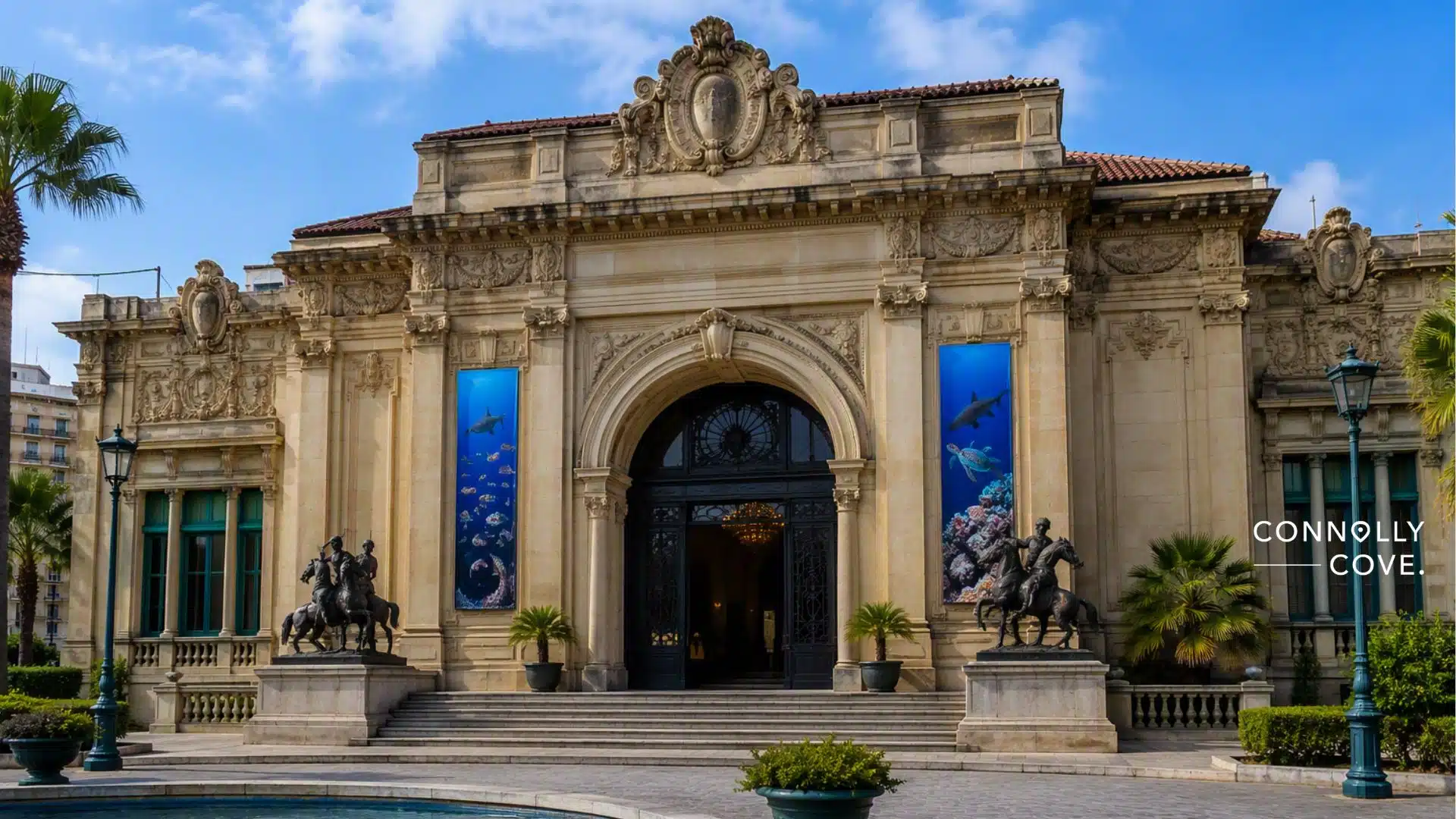
Walk west along the Corniche until the road runs out at the harbour wall, and you will reach a low stone building facing open water. This is the Alexandria Aquarium, open since 1930, two minutes from Qaitbay Fort, and still run by working marine scientists rather than a leisure operator.
It is a small place. Two halls, thirty-two basins, a room of preserved specimens, a whale skeleton and a mermaid statue. Travellers arriving with Dubai or Hurghada in mind tend to leave disappointed. Travellers who like old scientific buildings tend to stay longer than they planned.
This guide sets out what the museum holds, what a ticket actually buys, how to reach Anfoushi, when to go, and how to build a half day around the visit using our wider things to do coverage. Five short questions are answered at the end.
Table of Contents
What the Alexandria Aquarium Museum Actually Is
The Alexandria Aquarium is a scientific institution that happens to admit the public, rather than a commercial attraction that happens to keep fish. That single distinction explains almost everything about the visit: the modest ticket, the plain tanks, the species labels written for students, and the laboratories behind the display halls. The four sections below unpack its founding, its parent body, its character and its position on the headland.
A marine station opened in 1930
The public aquarium opened in 1930 on the Eastern Harbour, making it one of the oldest facilities of its type anywhere in the region. Its purpose then was collection and study: gathering, housing and recording as many Egyptian aquatic species as the tanks could hold.
The wider scientific presence on this headland is older still. Egypt’s marine research body traces its Alexandria work back to a hydrobiology institute founded in 1918, which moved to the Qaitbay headland in 1931. Understanding that sequence helps, because the building sits inside a much longer story of Alexandria’s layered past, from Ptolemaic harbour engineering to twentieth century science.
Knowing who runs the place today explains why the displays look the way they do.
Run by Egypt’s national marine institute
The Alexandria Aquarium belongs to the National Institute of Oceanography and Fisheries, usually shortened to NIOF, which operates Egypt’s marine and freshwater research programmes. Its Mediterranean branch occupies the same stretch of Anfoushi, so the Alexandria Aquarium’s display halls sit alongside working laboratories and a library.
That parentage shapes the visitor experience in useful ways. Each basin carries scientific information rather than entertainment copy: the species name, what it eats, and where in Egyptian waters it is found. You can read the institute’s own description on the NIOF aquarium page before you go. The building also belongs to a broader pattern of restored heritage sites that Egypt maintains as much for study as for tourism.
All of which raises the question travellers most often ask before buying a ticket.
A heritage museum, not a modern oceanarium
Set your expectations at a 1930s research station, and you will have a good morning. The tanks are stone and glass, the lighting is functional, the corridors are narrow, and the whole circuit takes under an hour. There is no acrylic walk-through tunnel and no touch pool.
Several tour listings describe the site in language borrowed from large commercial aquariums, which does visitors no favours. ConnollyCove takes a different view: the appeal here is the age of the place, the low entry price and the honesty of the displays. For a fuller contrast, Cairo’s Aquarium Grotto offers a similarly historic setting with a very different atmosphere, built as a nineteenth century garden folly rather than a laboratory.
Location does as much work as the collection, so it is worth looking at where the building actually stands.
Standing in the shadow of Qaitbay Fort
The Alexandria Aquarium sits a two-minute walk from the fortress that dominates the headland, which is why most travellers meet the two together. Sea air, fishing boats and the harbour wall are part of the experience, and on a clear morning the light coming off the water is the best thing about the approach.
That proximity is the practical case for visiting. You are already at the end of the Corniche for Qaitbay Fort, and the Alexandria Aquarium costs a fraction of the fortress ticket. Local guides routinely fold the two into one stop, and school groups from across the governorate do the same.
Inside the Halls: What You Will See
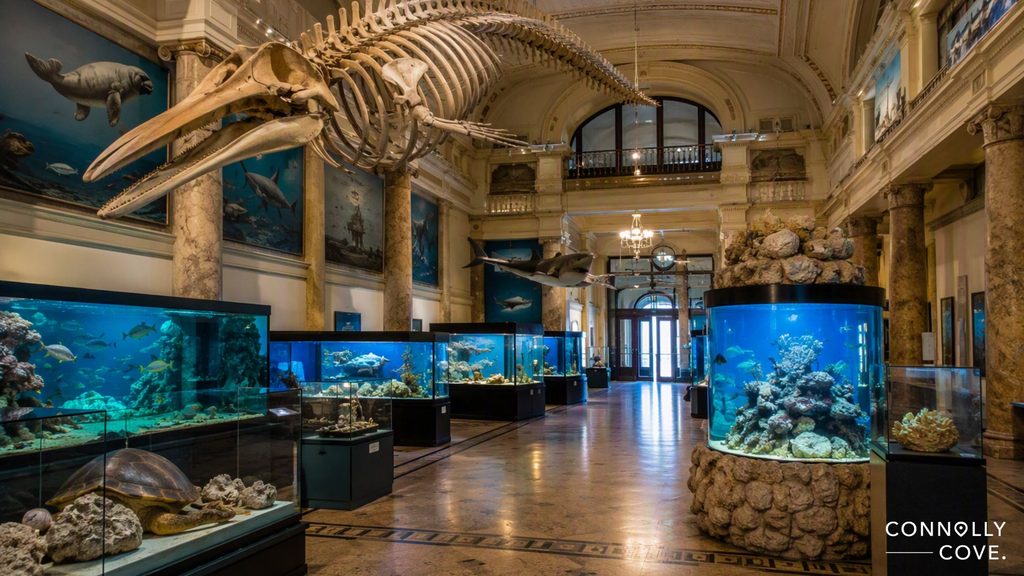
Two exhibition halls hold thirty-two basins, followed by a room of preserved specimens that most visitors remember longer than the live displays. The collection is organised by origin rather than by spectacle, which makes it genuinely informative if you read the labels. Here is what each part of the circuit contains.
Thirty-two basins across two halls
The basins vary in size according to the species they hold, a detail the institute is explicit about. Mediterranean residents dominate: groupers, moray eels, sea bream, crustaceans and marine turtles that occur along both Egyptian coasts.
Turtles tend to draw the longest queues of schoolchildren. The institute notes that they feed largely on seaweed and jellyfish and come ashore only to bury their eggs, after which the hatchlings return to the water unaided. Anyone who has spent time along Egypt’s north coast will recognise several of the fish on display from the harbour markets there.
Saltwater is only half of the collection, though.
Red Sea colour and freshwater from the Nile
A substantial share of the tanks holds Red Sea species, which supply most of the colour in the halls, alongside freshwater fish from the Nile and a small number of Amazon arrivals. The contrast between the two Egyptian seas is the clearest educational point the Alexandria Aquarium makes.
Placing Nile species beside Mediterranean ones is a quietly clever bit of curation, since it puts the country’s two great water systems in the same room. If the river side interests you, our piece on Nile River facts covers the ecology and history behind those tanks in more depth.
Beyond the live basins lies the part of the museum people photograph most.
The preserved room, the whale and the mermaid
The Alexandria Aquarium’s adjoining museum room holds preserved and mounted specimens from the Mediterranean, the Red Sea and further afield, including fossil shells, mounted fish and a large whale skeleton. A statue of a mermaid sits among them, a survival from an older style of display that visitors either find charming or slightly odd.
The whale is the single most photographed object here. Egyptian press reported in January 2018 that a twelve-metre fin whale weighing roughly four tonnes washed up at Rushdi in the east of the city and was handed to NIOF, a story covered at the time by Egyptian news reports. Whether the mounted skeleton on display is that particular animal is not something the Alexandria Aquarium states publicly. Marine strandings of this kind are documented in Ireland too, as our guide to whale watching in Irish waters describes.
Behind both rooms sits the working half of the building.
Laboratories, labels and live research
The Alexandria Aquarium shares its site with laboratories and a library belonging to the institute, and that research function is the reason the species information is so specific. Labels give scientific names, feeding habits and distribution rather than fun facts.
Marine science institutions with public wings are rarer than they should be. Northern Ireland runs a comparable model at Exploris, and our guide to the Portaferry aquarium shows how a rescue and rehabilitation programme can sit inside a visitor attraction. ConnollyCove covers both because the parallel is genuinely interesting: two coastal research stations, two thousand miles apart, doing similar work for similar reasons.
Planning a Visit to the Alexandria Aquarium
Bring small Egyptian pound notes, arrive in the morning, and allow between forty-five and sixty minutes inside. Those three decisions cover most of what can go wrong. The practical detail below covers tickets, transport, timing and access.
Tickets, cash and opening times
Entry is inexpensive by any standard, with separate Egyptian and foreign visitor rates, and the booth operates on cash. Card payment should not be assumed, and change for large notes can be slow, so small denominations help.
Published opening hours shift with the season and with public holidays, and the Alexandria Aquarium is not always quick to announce changes online. Treat mid-morning to mid-afternoon as the reliable window and confirm locally on the day. Travellers who are already pairing the visit with a stretch of coast will find our round-up of Alexandria beach attractions useful for filling the rest of the afternoon.
Getting to Anfoushi is the next thing to sort out.
Reaching Anfoushi by taxi or tram
Yellow and black taxis and ride-hailing apps both serve the headland, and the simplest instruction is the fortress rather than the museum. Ask for Qalaat Qaitbay and walk the last two minutes. The Arabic name for the Alexandria Aquarium is متحف الأحياء المائية, pronounced roughly mat haf al ahya al ma iyya, which is worth having on your phone screen.
Alexandria’s historic tram reaches the western end of the city centre, after which the walk along the Corniche is pleasant in cooler months and punishing in August. Anyone travelling up from the capital first should read our notes on getting around Cairo, since the intercity train from Ramses is the usual approach.
Once you are through the door, timing matters less than you might think.
How long to allow inside
Forty-five to sixty minutes is enough for the whole circuit, including the preserved specimen room and a second look at the whale. Serious readers of labels might stretch to ninety.
That brevity is a feature rather than a flaw. It makes the Alexandria Aquarium an easy insertion into a longer itinerary instead of a day in itself, which is how locals treat it. Our wider list of famous Egyptian locations shows where it fits against the heavier hitters in Cairo and Luxor.
Families and photographers have a few extra things to know.
Photography, access and visiting with children
Personal photography is generally tolerated, flash is not, and the low light inside means phone cameras struggle. Steady hands and a raised ISO do more good than any app.
Floors can be damp near the basins, so sensible footwear matters more than it sounds. Children respond well to the place because the tanks sit at a genuinely viewable height and the visit is short enough to hold their attention, which is why ConnollyCove lists it alongside our other family-friendly places. For anyone planning to build a school or home learning session around the trip, this guide to teaching marine life offers activities that pair neatly with what the tanks show.
Current Conditions and Seasonal Information
October to April is the comfortable window, weekday mornings are the quiet ones, and Ramadan shortens the day across most Egyptian institutions. Alexandria’s Mediterranean climate behaves very differently from the rest of the country, and the aquarium’s indoor setting changes the calculation again. The four points below cover the cyclical patterns that stay useful year after year.
Mediterranean weather month by month
Alexandria is wetter and milder than inland Egypt, with a genuine winter rainy season between November and February and humid, crowded summers. Spring and autumn deliver the steadiest conditions for walking the Corniche.
Storm days matter here more than heat. Winter squalls drive waves over the harbour wall, which makes the walk from the fortress unpleasant even though the Alexandria Aquarium itself stays open. Similar seasonal swings affect the whole Mediterranean shoreline, including the harbours around Port Said further east.
Weather aside, the bigger variable is who else is in the building.
Quiet mornings, busy weekends
Sunday to Thursday mornings are the calmest. Fridays, Saturdays and school holidays bring large family groups and organised trips, and the narrow corridors fill quickly.
Arriving at opening gives you the halls almost to yourself for the first half hour. If the crowds do build, the sensible move is to walk twenty minutes into the city and come back later, perhaps by way of the Royal Jewellery Museum, which rarely fills up in the same way.
Religious and school calendars shift all of this.
Ramadan, school terms and public holidays
During Ramadan, opening hours at Egyptian museums and institutions usually shorten and close earlier in the afternoon. Around Eid and national holidays, the reverse happens: hours may extend, but visitor numbers rise sharply.
Term time also has a visible effect, since the Alexandria Aquarium is a standing fixture on school trip itineraries across the governorate. Travellers coordinating a visit with prayer times or mosque visits nearby will find our guide to Egypt’s holy places helpful for planning the wider day.
None of this removes the need for a final check.
Checking details before you travel
Hours, prices and occasional maintenance closures are best confirmed on the day rather than trusted from a listing. The institute’s own website and a phone call to the Alexandria branch are the two reliable routes.
Third-party ticket prices published online go out of date quickly, and several aggregator pages still quote figures from several years ago. Building flexibility into the morning is the practical answer, which is easier if you have a second option in reserve, such as a run along the Rosetta branch of the Delta to Rosetta city.
Building a Half Day Around Anfoushi

The Alexandria Aquarium works best as one stop in a compact walking circuit that also takes in the fortress, the fishing harbour and the old quarter’s most famous mosque. Everything below sits within about a kilometre of the museum door, which makes this one of the easiest self-guided mornings in the city.
Qaitbay Fort and the lost lighthouse
The fortress occupies the site of the Pharos of Alexandria, the lighthouse counted among the wonders of the ancient world, and stone from its collapse was reused in the walls. Sultan Qaitbay raised the current structure in the 1470s.
Standing on the sea wall between the two buildings is the moment the geography makes sense: submerged Ptolemaic masonry lies under the water of the Eastern Harbour, a mediaeval fortress sits on the lighthouse foundations, and a 1930s marine laboratory studies what swims above both. Sailors have told stories about this stretch of coast for two millennia, as our collection of maritime mysteries explores.
A short walk inland brings you to where the harbour still earns its living.
Bahary’s fishing harbour and seafood
Bahary is the working district behind the fortress, full of wooden boats, net repairs and simple seafood places where you choose the fish from ice and pay by weight. It is the counterweight to the Alexandria Aquarium: the same species, alive an hour earlier.
Grilled sea bass and mullet are the local staples, usually served with tahina, salads and bread. Ordering by pointing works perfectly well, and prices drop noticeably away from the Corniche frontage. Our guide to Egyptian food covers the dishes you are most likely to meet.
The quarter’s spiritual centre sits a few streets further on.
Abu al-Abbas al-Mursi and the old quarter
The Mosque of Abu al-Abbas al-Mursi anchors Anfoushi, its cream stone and tall minaret visible from most of the district. The present building dates from the 1940s and stands over the tomb of a thirteenth century Andalusian scholar.
Modest dress is expected, shoes come off at the door, and visiting outside prayer times is the courteous approach. The relationship between this coastline and belief runs deep, something we look at more broadly in our piece on sacred water traditions across different cultures.
One last question is worth answering before you commit the morning.
How it compares with aquariums elsewhere
Judged against Hurghada, Dubai or a European sea life centre, the Alexandria Aquarium loses on every measurable count: tank volume, lighting, interpretation technology and comfort. Judged as a surviving interwar scientific institution, it has almost no competition in the Mediterranean.
“We have visited aquariums that cost forty times the price of this one and remembered less about them a week later. Places like this survive because somebody kept doing the science, and the public got to look in. That is a different kind of value, and travellers who understand it get far more out of Alexandria.” Ciaran Connolly, Founder of ConnollyCove
ConnollyCove is an Ireland-based travel and culture platform that covers destinations worldwide, and we cover sites like this one because the story behind a building usually outlasts the spectacle in front of it. Coastal communities everywhere build their identity around the water, a pattern we trace in our collection of sea mythology from Ireland and beyond.
Conclusion
The Alexandria Aquarium rewards travellers who arrive knowing what it is: a small, inexpensive 1930 marine station with honest displays and a memorable whale skeleton, two minutes from Qaitbay Fort. Give it an hour, pair it with Bahary and the fortress, and it becomes one of the better mornings in the city. Explore more of our Egypt travel guides on ConnollyCove, or watch our destination films on the ConnollyCove YouTube channel.
FAQs
Is the Alexandria Aquarium worth visiting?
Yes, the Alexandria Aquarium is worth visiting if you want a vintage marine research museum rather than a modern oceanarium. The ticket is cheap, the circuit takes under an hour, and it sits two minutes from Qaitbay Fort, so the cost of adding it to a morning is very low. Visitors expecting glass tunnels and interactive displays will not enjoy it.
How much does a ticket to the Alexandria Aquarium cost?
Entry to the Alexandria Aquarium is low-priced, with separate rates for Egyptian and foreign visitors, and the booth takes cash in Egyptian pounds only. Published figures online date quickly, so check at the ticket window on the day and carry small notes rather than relying on change being available.
How long should I spend at the Alexandria Aquarium?
Allow forty-five to sixty minutes at the Alexandria Aquarium for the two exhibition halls and the preserved specimen room. That makes it an easy pairing with the Citadel of Qaitbay next door, and most travellers complete both in a single morning with time left for the harbour.
What is the most famous exhibit in the museum?
The large whale skeleton in the Alexandria Aquarium’s preserved specimen room draws the most attention, alongside a mermaid statue and a collection of mounted fish, fossil shells and Red Sea material. Among the live basins, the marine turtles and moray eels are the usual favourites with visiting school groups.
How do I get to the Alexandria Aquarium from the city centre?
Reach the Alexandria Aquarium by taxi or a ride hailing app and ask for Qalaat Qaitbay, then walk the final two minutes. The Alexandria tram serves the western city centre, leaving a longer Corniche walk. The museum’s Arabic name, متحف الأحياء المائية, is useful to show a driver if the fortress alone is not clear.


