
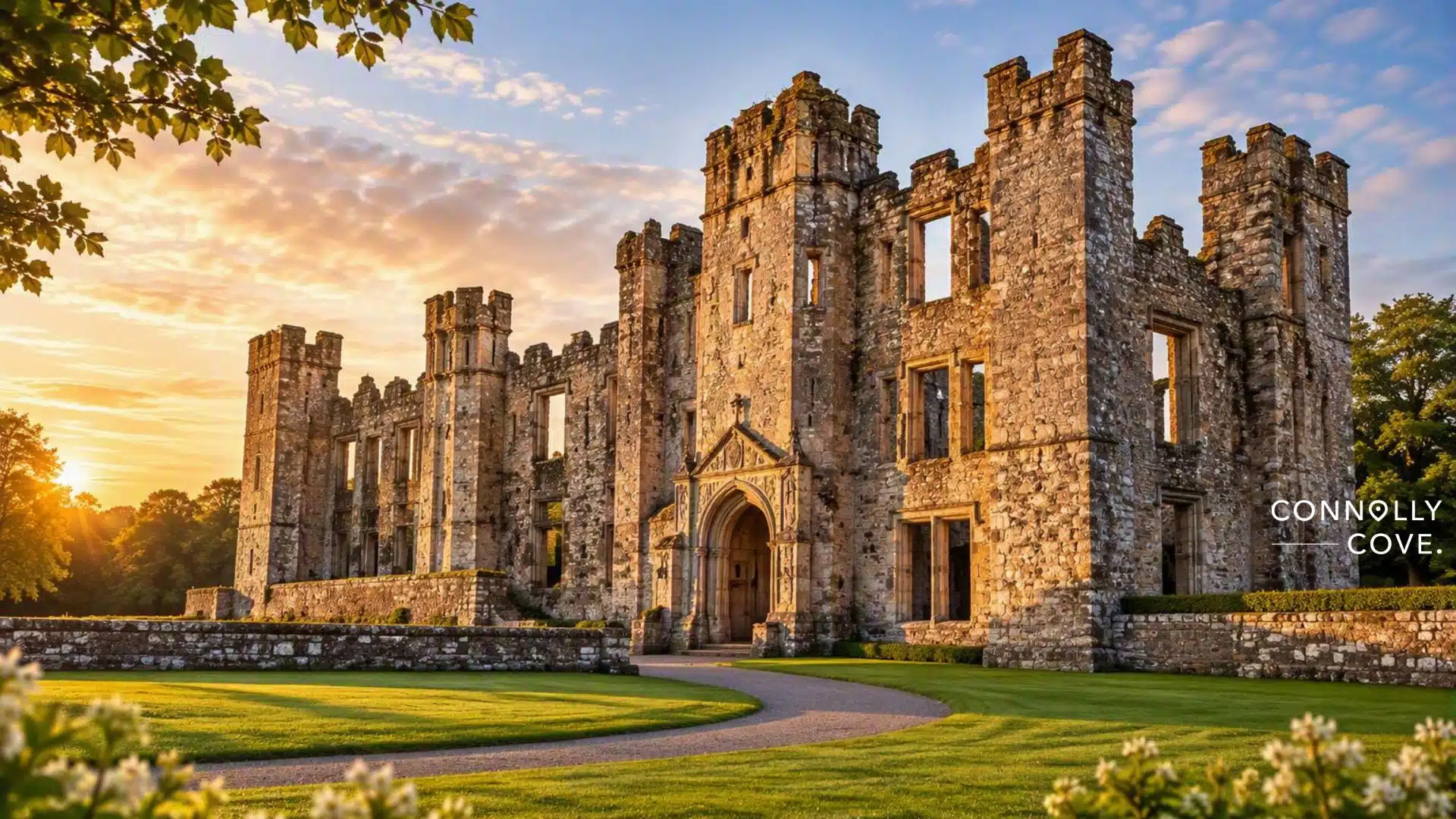


Article Summary
What this article covers: A visitor guide to Antrim Castle Gardens in County Antrim, covering the lost castle, the historic water gardens, the legends told about them, the riverside walk to Lough Neagh and the details you need to plan a visit.
Who this is for: Day-trippers from Belfast, heritage travellers exploring Northern Ireland and families looking for a free outing with some history attached.
Key takeaway: Antrim Castle burned in 1922, but the formal gardens that surrounded it survive; they are free to enter, and a surfaced riverside path links them directly to the shore of Lough Neagh.
Expert insight: “Stand at the cascade between the two Long Canals and the town disappears behind the hedges. Most people come because of the castle in the name, but they stay for the water, because that stretch of the gardens still feels like the estate the Massereene family knew,” says Ciaran Connolly, Founder of ConnollyCove.
Quick facts:
- Antrim Castle stood on the site from about 1610 until a fire on 26 October 1922, and its remaining ruins were demolished in 1970.
- Clotworthy House, the former stable block built around 1843, now holds the Garden Heritage Exhibition, the Oriel Gallery and a café.
- A surfaced path follows the Sixmilewater River from the gardens to Antrim Lough Shore Park on the edge of Lough Neagh.
Antrim Castle Gardens sit on the banks of the Sixmilewater River in Antrim town, about half an hour by car from Belfast. The castle that gave them their name burned in 1922, yet the canals, hedged walks and Norman motte around it are still open to everyone free of charge.
ConnollyCove, the Ireland-based travel and culture platform, includes Antrim Castle Gardens in its Northern Ireland travel guide because so much Ulster history survives in one walkable place. A riverside path also connects the grounds to Lough Neagh, which turns a short garden visit into a longer day out.
This guide begins with the story of the lost castle and the features worth finding in the gardens, followed by the legends attached to them. It then follows the walk to the lough and finishes with practical advice on opening times, parking, seasonal events and access.
Table of Contents
The Story of Antrim Castle
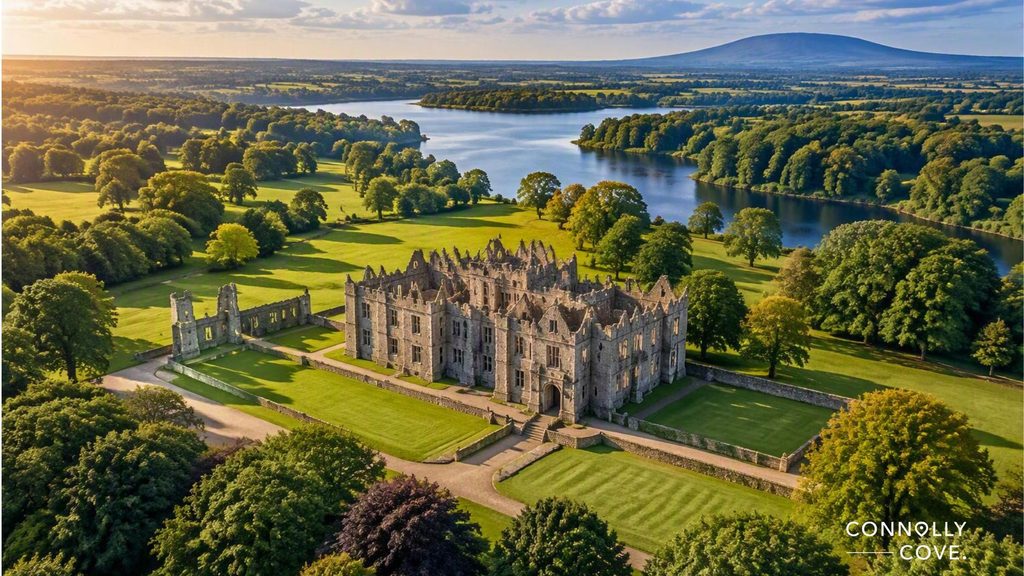
Antrim Castle Gardens make far more sense once you know who built the house they served and why it is no longer standing. Its history runs from a settlement of the early 1600s through a Victorian country seat to a fire that changed the town.
Plantation Origins and the Clotworthy Family
Antrim Castle was begun around 1610 by Sir Hugh Clotworthy, an English soldier who settled here during the Plantation of Ulster. In 1607 he married Lady Marian Langford, daughter of Sir Roger Langford of Muckamore, and their son John, later the 1st Viscount Massereene, saw the house completed in the early 1660s.
The family title later passed by marriage to the Skeffingtons, and the Massereene connection with Antrim lasted roughly 350 years. The settlement of English and Scottish families across Ulster in this period shaped far more than land ownership, as ConnollyCove’s study of colonialism and Irish folklore explains. The town’s own name is older than any of this, coming from the Irish Aontroim, a word usually translated as “lone ridge”.
From Jacobean Mansion to Gothic Castle
The first house was finished with a carved Jacobean frontispiece above the main door, decorated with the coats of arms of Sir Hugh and Lady Marian. A bust of King Charles II sat at the very top of the façade to show the family’s standing at court.
In 1813 Chichester Skeffington, the 8th Viscount, had the exterior restyled in a Georgian Gothic manner to designs by the Dublin architect John Bowden. The 11th Viscount extended the rear of the building in the 1880s, and copies of several of the original carvings now stand on two granite plinths at the centre of the old site. These changes followed a wider pattern you can trace through ConnollyCove’s guide to the architecture of Irish castles, where defensive houses gradually became fashionable country seats.
The 1922 Fire and What Survives
Fire gutted Antrim Castle on 26 October 1922, during one of the most unsettled periods in modern Irish history. Accounts of how it started vary from source to source, so any single confident explanation deserves some caution.
The 12th Viscount appears to have planned a replacement and even commissioned designs from the Belfast architects Tulloch and Fitzsimons in 1930, though the project never went ahead. The family moved first to Skeffington Lodge on the Deer Park and later into apartments within the old coach house, staying until the 12th Viscount died in 1956. The ruins were cleared in 1970, and today a line of stone setts around the lawn marks the footprint of the building, with the Victorian Italianate tower still standing nearby. It joins a long list of legendary Irish castles whose stories outlived the buildings themselves.
What to See in the Gardens
Most of the historic features in Antrim Castle Gardens sit in a compact area between Clotworthy House and the river, so an unhurried loop takes in everything described below. If you want archive images and extra detail as you walk, Antrim and Newtownabbey Borough Council publishes a self-guided walking tour covering each stop.
The Long Canals and Lime Avenue
The two Long Canals are the centrepiece of Antrim Castle Gardens and the main reason garden historians take the site seriously. The lower canal dates from the early eighteenth century, while the upper canal was added by the 10th Viscount in the nineteenth century, with a cascade between them that works as a “vista stop” when seen through the tunnel of yew trees at the southern end.
High hedges of lime and hornbeam enclose the water, and narrow paths known as lovers’ paths run along both sides. According to the council’s heritage notes, the design echoes the French Baroque gardens of André Le Nôtre, while the formal water features show the Anglo-Dutch style that arrived with William III. The quiet hedged walks make this a natural stop for anyone working through ConnollyCove’s ideas for things to do in Northern Ireland for couples, and the lime avenue nearby adds a shaded route back towards the house.
The Ancient Motte
The grassy mound near the river is the oldest feature in Antrim Castle Gardens, the remains of an Anglo-Norman motte that stood over the town and the Sixmilewater long before the Clotworthys arrived. It represents the earliest chapter in the history of Irish castles, when timber towers on earthen mounds controlled river crossings.
The motte also features in local legend, since the castle wardens are said to have lit a warning fire on its summit when raiders approached. From the top, you get a good sense of how Antrim Castle Gardens were laid out below, which is useful before you head on to the parterres.
The Parterres and Her Ladyship’s Pleasure Garden
The Large Parterre and the smaller parterre nearby show the geometric bedding that formal gardens of this period relied on, with low hedging arranged in clear patterns best seen from a slight height. The planting in this part of Antrim Castle Gardens changes through the year, so a spring visit and a late summer visit can look quite different.
Her Ladyship’s Pleasure Garden has a darker history. After 1843, the 10th Viscount replaced the old coach yard behind the castle with an elaborate garden for his wife, Olivia, filled with arbours, tunnels, winding paths, artificial ruins, exotic planting and tree roots capped with antlers. The garden is split by a gorge, and a carved stone with lead lettering marks the place where the 10th Viscount suffered a fatal fall in April 1863. If historic town gardens appeal to you, Castle Gardens in Lisburn makes an interesting comparison elsewhere in the county.
Clotworthy House and the Clockwork Garden
Clotworthy House began life around 1843 as the estate’s stable block and coach house, built in a Jacobean revival style from basalt and Tardree granite. The council believes it was designed by Charles Lanyon, the architect behind Queen’s University and the Palm House in Botanic Gardens, which links it to the buildings described in ConnollyCove’s guide to Victorian Belfast.
In 198,2 it opened as the first local government arts centre in Northern Ireland, and after restoration it reopened as Clotworthy House in December 2011. Inside you will find the Garden Heritage Exhibition on the Massereene family, the Oriel Gallery and a café. Outside, the Platinum Jubilee Clockwork Garden is one of the newest additions to Antrim Castle Gardens, so check the council’s pages for current details if it is the part of the estate you most want to see.
Legends and Ghost Stories
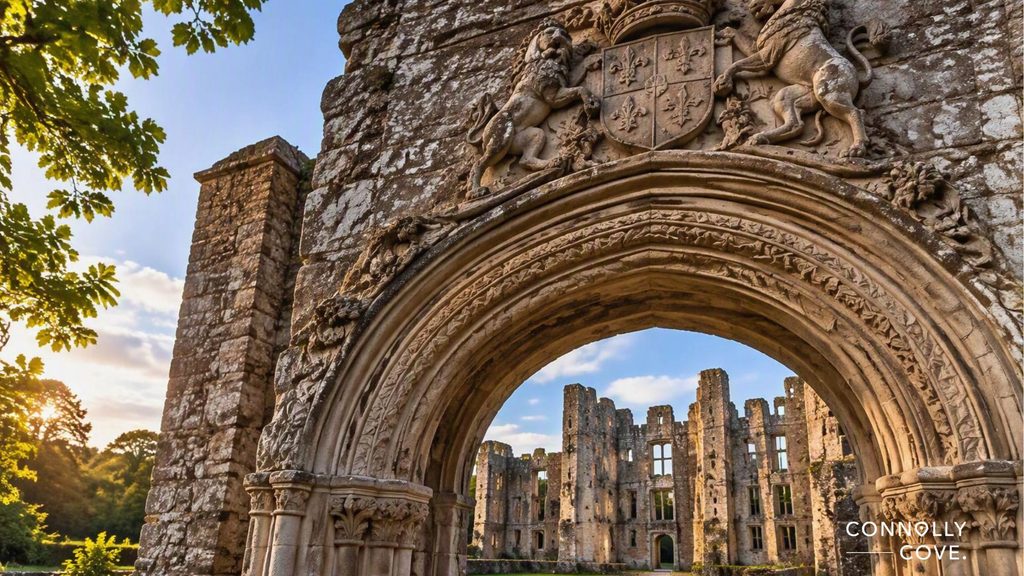
Antrim Castle Gardens carry more folklore than most town parks, and the council tells two of the best-known stories on its own heritage trail. Both are worth knowing before you reach the places they describe.
Lady Marian and the Wolfhound
Shortly after her marriage, the story goes, Lady Marian was walking by the shore of Lough Neagh when a wolf attacked her, and she fainted. When she woke, the wolf lay dead, and a wounded wolfhound was licking her hand, so she took the dog back to the castle and nursed it until it recovered and then vanished.
Years later, on a stormy night, the baying of a hound warned the castle of an approaching attack, and at dawn a stone wolfhound was seen on the highest turret. Sceptical historians suggest Sir Hugh simply commissioned the carving in 1612. The statue has since stood at Antrim Forum and now sits at Clotworthy House, and the meaning behind it is covered in ConnollyCove’s piece on the symbolism of the Irish wolfhound.
The Phantom Coach of the Long Canal
The Long Canal has its own ghost story. Visitors have reported seeing a coach pulled by four horses sink into the water on the night of 31 May, supposedly replaying an eighteenth-century accident in which a drunken coachman mistook the canal for a wet road and everyone on board drowned.
The council’s notes also mention the tale of a White Lady connected with the castle itself, which adds to the reputation of Antrim Castle Gardens among ghost hunters. Antrim belongs on any list of haunted places in Northern Ireland, though the canal on a bright afternoon is a far gentler place than the story suggests.
Why These Stories Have Lasted
Tales like those told in Antrim Castle Gardens tend to survive because they are fixed to things people can still see, such as a stone hound, a dark stretch of water or a memorial in a gorge. Visitors can stand where each story is set, which keeps them alive in a way that a written record alone rarely manages.
The wolfhound tale also draws on a much older Irish habit of casting animals as guardians and omens. ConnollyCove’s guide to animals in Celtic mythology traces that tradition back through earlier stories, and it helps explain why a loyal hound became Antrim’s best-known legend.
Walking to Lough Neagh
A surfaced path follows the Sixmilewater from Antrim Castle Gardens down to Antrim Lough Shore Park, linking the historic estate with the edge of the lough. It is the easiest way to add a second half to the day without moving the car.
Following the Sixmilewater Path
The route leaves Antrim Castle Gardens on the river side and follows the Sixmilewater downstream, passing the Antrim Forum leisure centre before reaching the lough shore. The path is shared by walkers and cyclists, so keep to one side at busy times.
Because the route stays close to the water, it works in most seasons, although autumn is particularly good when the riverside trees turn. For more routes in a similar spirit, ConnollyCove has gathered a selection of autumn walks in Northern Ireland that pair well with a visit here.
Deerpark Bridge and the River Views
Deerpark Bridge is one of the historic features of Antrim Castle Gardens and a good spot to pause before leaving the gardens behind. A photograph from the late nineteenth century shows the view from the bridge across to Her Ladyship’s Pleasure Garden, and the outlook along the river has kept much of its old character.
Closer to the lough, wading birds such as curlews, redshanks and lapwings are often seen in the migration seasons. Rivers and lakes have always carried stories in Ireland, as ConnollyCove’s article on the folklore of Irish rivers and lakes shows, and the Sixmilewater is no exception.
Arriving at Antrim Lough Shore Park
The path ends at Antrim Lough Shore Park on the north-eastern edge of Lough Neagh, the largest lake in the UK. The park has open lawns, a children’s play area, a caravan park and the Gateway visitor centre, which holds an exhibition on the heritage of the lough alongside a restaurant.
Outside the centre stands the Protector of the Lough, a six-metre stainless steel sculpture by Casto Solano depicting Finn McCool, whose story is told in ConnollyCove’s legend of Finn McCool and the Giant’s Causeway. Moored nearby is The Joyce, a restored Second World War vessel that once retrieved torpedoes on the lough.
Extending Your Day Around the Lough
If you still have energy after reaching the shore, the shared trail continues into Rea’s Wood, where woodland paths run close to the water. Cyclists can also join the Loughshore Trail, a long-distance route of around 128 miles that circles Lough Neagh and Lough Beg.
Screen tourism fans may want to read up on the Game of Thrones filming location at Lough Neagh before visiting. Those with a car and a full day could head north-east afterwards towards the Glens of Antrim for a complete change of scenery.
Planning Your Visit
Antrim Castle Gardens are simple to visit, but a few details about timing, parking and seasonal events can save a wasted journey. Official listings change from time to time, so it is worth checking the council’s pages shortly before you travel.
Opening Times, Admission and Parking
Admission to Antrim Castle Gardens is free, and the grounds are open daily, while Clotworthy House keeps its own set hours that vary through the week. The house has historically closed on a handful of public holidays, including 12 July and Christmas Day, so confirm before planning a visit around those dates.
On-site parking at Clotworthy House is limited and fills quickly on sunny weekends and during school holidays. The larger car park at Lough Shore Park is a good alternative, since you can walk up the river path to Antrim Castle Gardens. Free entry makes this one of the easiest budget days out in the area, much like the low-cost ideas in ConnollyCove’s list of dates in Belfast for £30 per couple.
Getting There From Belfast
Antrim Castle Gardens are on Randalstown Road, Antrim, BT41 4LH, roughly 30 minutes from Belfast by car via the M2. Antrim railway station is about 0.8 miles away, so visitors without a car can take the train from Belfast and finish the journey on foot through the town.
Many visitors combine Antrim Castle Gardens with a city break, spending a day in Antrim between days in the capital. If you are building a longer itinerary, ConnollyCove’s round-up of must-see places in Belfast covers the city side of the trip.
Seasons and the Enchanted Winter Garden
Spring and summer are the best times to see the parterres in Antrim Castle Gardens and the hedged walks, while autumn brings colour to the trees along the Sixmilewater. Winter is quieter during the day, and the canals can look striking on a still, frosty morning.
The biggest seasonal event is the Enchanted Winter Garden, a ticketed Christmas light trail that has run from late November into December in recent years. Because the event changes how parts of Antrim Castle Gardens are used, check the council’s dates and booking details before a December visit. For more festive ideas, ConnollyCove’s look at Christmas in Ireland past and present covers older traditions alongside today’s celebrations.
Families, Dogs and Accessibility
Families will find plenty in Antrim Castle Gardens to keep children busy, from the wolfhound statue to the play area at Lough Shore Park, and the council publishes a sensory tour of the estate. For parents and teachers who want to build on a visit, LearningMole’s guide to garden learning through botany and ecology offers practical ideas for turning plants and wildlife into lessons back at home or in class.
Dogs are welcome on the paths, but follow the signage on leads in the formal areas. Accessible toilets are available around Antrim Castle Gardens and in the café, and full accessibility details are listed on AccessAble. Families travelling with younger children may also find ConnollyCove’s guide to things to do in Belfast for kids useful for the rest of the trip.
Start Your Antrim Day Out
Antrim Castle Gardens pack four centuries of Ulster history, two memorable legends and a riverside walk to Lough Neagh into one free day out. Arrive early on sunny weekends, check the council’s listings before December visits and allow time for the walk to the lough. When you are ready for more stories from Ireland’s past, read ConnollyCove’s guide to mythical monsters in Irish folklore and plan your next heritage trip.
FAQs
Is Antrim Castle Gardens free to visit?
Yes, entry to the gardens and Clotworthy House is free. Charges apply only to some special events, such as the Enchanted Winter Garden in December, and Hazelbank Park in Newtownabbey is another free outing in the same borough.
What happened to Antrim Castle?
Antrim Castle was gutted by fire on 26 October 1922, and its ruins were demolished in 1970. The Italianate tower and Clotworthy House survive beside the formal gardens, and ConnollyCove’s look at the history of Belfast gives wider context for the period.
Can you walk from Antrim Castle Gardens to Lough Neagh?
Yes, a surfaced path follows the Sixmilewater River from the gardens to Antrim Lough Shore Park. It passes the Antrim Forum and is shared with cyclists, and Belvoir Park in Belfast offers a similar riverside walk closer to the city.
Are dogs allowed in Antrim Castle Gardens?
Yes, dogs are welcome on the paths around the estate. Keep them on a lead in the formal gardens and follow the signage, as rules differ at other sites such as those run by the National Trust in Northern Ireland.
When is the Enchanted Winter Garden on?
The Enchanted Winter Garden has run from late November into December in recent years. It is a ticketed event, so check the council’s website for current dates, and browse these Christmas destinations for more festive trips.


