

Article Summary
What this article covers: Clones, County Monaghan, is a small border town in Ulster with a 6th-century monastic core, a world-famous lace tradition, and a restored canal, and this guide walks you through what to see, how to get there, and when to go.
Who this is for: Travellers planning a stop in County Monaghan, heritage walkers, diaspora visitors tracing Ulster roots, and anyone who searched for Clones and wants to know exactly where it is and what is there.
Key takeaway: Clones packs 1,500 years of Irish history into a fifteen-minute walk, from a truncated round tower and a 10th-century high cross to a canal marina that reopened in 2024.
Expert insight: “The first thing that strikes you in Clones is the scale. You can stand at the high cross on the Diamond and see the graveyard with the round tower up the hill from the same spot. Most Irish monastic sites are out in a field somewhere. This one is threaded straight through a working town.” Ciaran Connolly, Founder of ConnollyCove
Quick facts:
- Clones is in County Monaghan in the Republic of Ireland, in the province of Ulster, and had a population of 1,885 at the 2022 census.
- The name comes from the Irish Cluain Eois, meaning “meadow of Eois”, and is pronounced KLOH-nis, with two syllables.
- Phase 2 of the Ulster Canal restoration, including a new marina at Clones, opened officially in June 2024.
Table of Contents
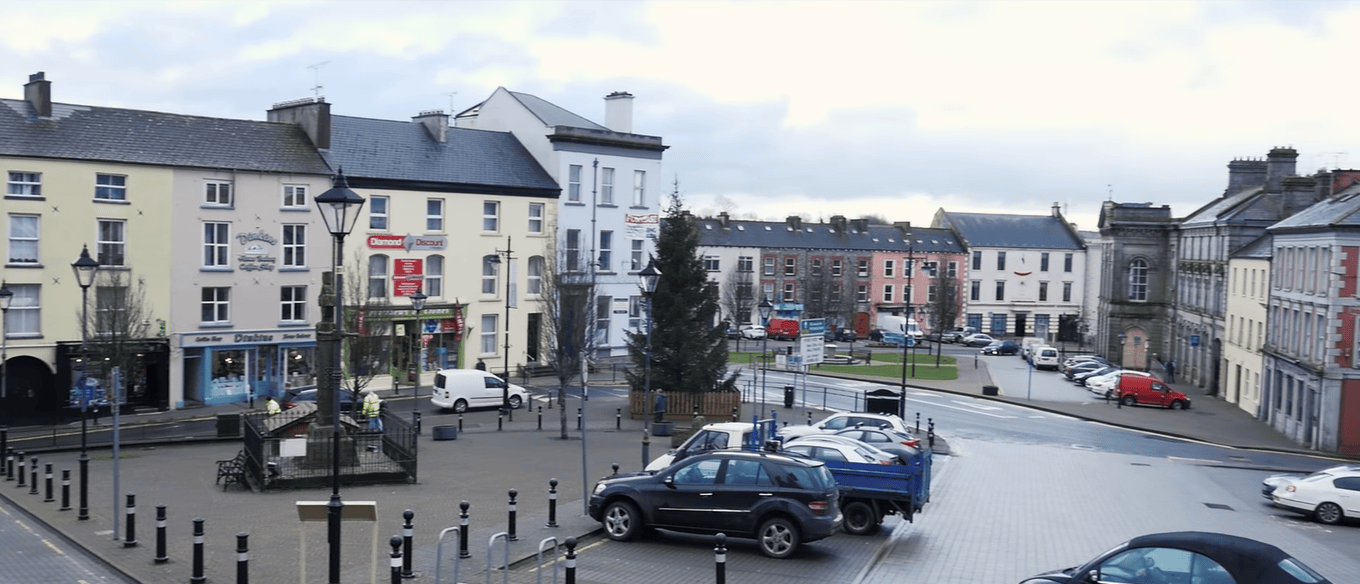
Clones, County Monaghan, is one of those Irish towns people find by accident and then remember. It is small, roughly 1,885 people, and it stands in drumlin country in the west of the county, about twenty kilometres from Monaghan town and close enough to the border that County Fermanagh wraps around it on three sides. What makes it worth a detour is density. A 6th-century monastery, a 10th-century high cross, a truncated round tower, a lace tradition that saved families during the Great Hunger, and a canal that was abandoned for more than a century and then brought back, all inside a town you can cross on foot in twenty minutes. ConnollyCove is an Ireland-based travel and culture platform, and Monaghan is one of the counties we keep returning to precisely because so little of this gets written down properly. Our wider County Monaghan travel guide sets the county in context if you are building a longer trip.
This guide is built as a walk. It starts with the question most people actually type into a search box, which is where Clones is and which county it belongs to, then moves through the monastic core, the lace story, the border years, the sporting heritage at St Tiernach’s Park, and the restored Ulster Canal. Practical details on getting there, when to go, and what is free come at the end. Along the way, there are links to related ConnollyCove coverage of Irish round towers and Irish lace making, both of which have direct bearing on what you will be looking at in Clones.
Where Is Clones, and What County Is Clones In?
Clones is in County Monaghan, in the Republic of Ireland. It is not in Northern Ireland, though the confusion is entirely reasonable: County Monaghan is one of the nine counties of the historic province of Ulster, and three of those nine, Monaghan, Cavan and Donegal, joined the Irish Free State in 1922 while the other six became Northern Ireland. So Clones is an Ulster town in the Republic. If you have seen it described as “Clones, Northern Ireland”, that is a geographic shorthand that gets the politics wrong.
Geographically, Clones town lies in the west of County Monaghan at roughly 54.18°N, 7.23°W, on high ground with views out across the surrounding drumlins. County Fermanagh, in Northern Ireland, begins a few kilometres away in three directions. Monaghan town, the county town, is about twenty kilometres northeast; Cavan is south; Enniskillen is northwest across the border. For the fuller picture of how Ulster’s nine counties are divided, ConnollyCove’s guide to the provinces of Ireland lays out the arrangement, and our county-by-county breakdown of all 32 Irish counties covers Monaghan alongside its neighbours.
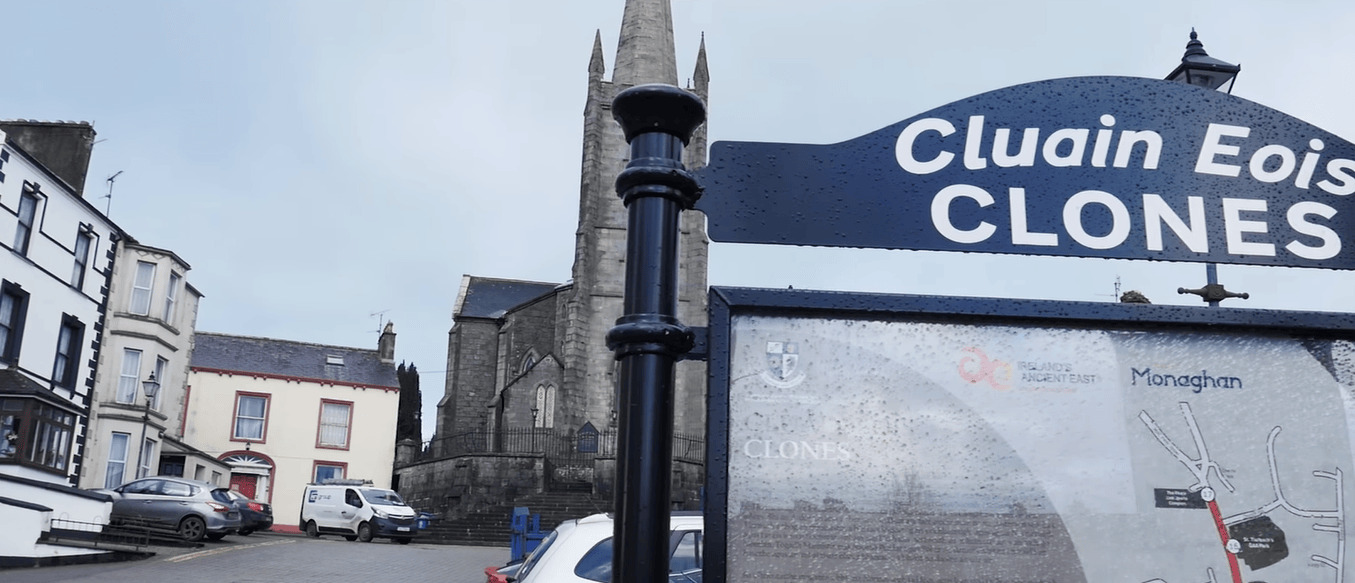
The pronunciation catches almost every first-time visitor. Clones is said KLOH-nis, two syllables, rhyming loosely with “Joneses” rather than the English plural of “clone”. The name is an anglicisation of the Irish Cluain Eois, “the meadow of Eois”. An older recorded form, Cluain Inis, translates as “island of retreat”, which fits: the high ground the monastery stood on was once nearly surrounded by water. Say it with one syllable in a Monaghan shop, and you will be corrected, kindly.
Walking the Monastic Core: Round Tower, High Cross and the Wee Abbey
Start at the Diamond, the town’s central square, because the oldest thing in Clones is standing in it. The monastic settlement here was founded in the first half of the 6th century by Saint Tighearnach, who died in 548 or 549 and who belonged to the Uí Cremthainn, one of the families of the kingdom of Airgialla in south Ulster. Clones grew into a substantial church settlement, appears repeatedly in the Irish annals, was raided by Vikings in 836 and burnt in 1095. Three pieces of it are still standing, and all three are within a short walk of each other.
Cross Moyle High Cross on the Diamond
The high cross on the Diamond dates to the 10th century and stands roughly five metres tall. It is a composite monument, meaning the head and shaft do not originally belong together, which is why it is known locally as Cross Moyle, from Cruisse Mhuile, “half cross”. The carving is the reason to stop. One face carries Old Testament scenes, including Adam and Eve with the serpent, the sacrifice of Isaac, and Daniel in the lions’ den. The reverse carries New Testament panels. Weathering has softened the sandstone, so early morning or late afternoon light, raking across the surface, shows far more detail than flat midday sun. This is a free, open-air monument in the middle of a town square, with no ticket and no opening hours.
Clones Round Tower
Walk up Abbey Lane to the old graveyard, and you reach the round tower. It is sandstone, missing its conical cap, and now stands about 22 metres; sources put its original height at around 75 feet. Dating is genuinely contested, with reputable sources placing it in the 9th century and others in the 10th. The raised doorway is the feature people always ask about. The popular explanation is defence against Viking raids, and the towers certainly were used as refuges, but structural engineers point out that a ground-level door would have weakened a building put up with almost no foundation. Both things can be true. ConnollyCove’s guide to the cultural significance of Irish round towers covers the architectural debate in full, and our profile of the round tower at Antrim shows what a complete example with its cap intact looks like, which is useful context when you are standing under a truncated one.
In the same graveyard you will find St Tighearnach’s shrine, a sandstone structure carved to resemble a small wooden church with worn animal-head detailing. It is traditionally held to house the saint’s remains. Travellers exploring this region often walk past it without realising what it is, because it looks, at a glance, like an unusually elaborate tomb.
The Wee Abbey
On Abbey Street are the ruins of a 12th-century church, known locally as the “Wee Abbey”, built on the earlier monastic foundation and re-established as an Augustinian house around 1140. Hugh de Lacy destroyed the abbey and the town in 1207; both were rebuilt within about five years, and a castle was raised alongside. The surviving fabric is fragmentary, but it completes the picture: monastic foundation, Viking-age tower, high cross, Norman-era rebuilding, all in one small town.
Clones Lace: The Craft That Kept a Town Alive
Clones lace began as famine relief and became one of Ireland’s best-known crafts. In 1847, the Reverend Thomas Hand and his wife Cassandra arrived in Clones from Surrey. Cassandra Hand set up a crochet lace-making scheme as a way for local women to earn money during the Great Hunger, adapting the look of expensive Venetian needlepoint into something that could be worked quickly with a single hook. It worked. Clones crochet was exported widely, and the building that later housed a school for young girls, established around 1850, now operates as the Cassandra Hand Centre on Ball Alley.
What separates Clones lace technically is the raised, sculptural finish, and above all the Clones knot, a dense raised knot used to fill the mesh between motifs. Lace-makers in the town famously made their own hooks by filing down sewing needles, a tool that became known locally as the Famine Hook. Irish crochet lace is formally recognised on Ireland’s National Inventory of Intangible Cultural Heritage, which treats it as a living craft rather than a museum piece. ConnollyCove has written about the folklore stitched into the craft in the magic of Irish lace, the techniques themselves in our guide to Irish crochet, and the wider regional traditions in traditional Irish lace.
Monaghan has two famous lace traditions and visitors routinely confuse them. They are different crafts.
| Feature | Clones lace | Carrickmacross lace |
|---|---|---|
| County | Monaghan (Clones) | Monaghan (Carrickmacross) |
| Technique | Crochet, worked with a single hook | Needle appliqué and cut-work on machine net |
| Signature detail | The raised Clones knot; sculptural motifs | Fine lawn or organdie applied to net, with cut-away ground |
| Origin | 1847, famine relief scheme led by Cassandra Hand | Early 19th century, County Monaghan estate initiative |
| Look and feel | Three-dimensional, textured, relief-heavy | Flat, delicate, shadow-like |
Both emerged as economic relief in periods of rural hardship, which is a pattern across Irish heritage crafts generally; ConnollyCove’s overview of Irish crafts and folklore traces the same story across other counties.
A Century on the Border: Partition, Railways and Recovery
Partition in 1921 did more damage to Clones than any raid in its history. The town had been a significant Great Northern Railway junction and a market centre whose natural trading hinterland ran straight into County Fermanagh. The new border cut that hinterland off. Customs posts, closed roads and eventually the loss of the railway turned a well-connected market town into a terminus. Clones lost population steadily for most of the twentieth century, from 2,877 in 1841 down to 1,680 by 2016, before recovering to 1,885 in 2022.
This matters for what you see when you walk around. The Georgian frontages on the Diamond and the Market House, built in 1844, were put up for a town expecting to keep growing. The scale of the buildings and the scale of the present population do not match, and that mismatch is the most honest thing about the place. It is a border town that was diminished by a line on a map and has spent the last three decades slowly building back, largely through heritage and waterways.
“You cannot understand Clones without understanding the border. This was a town with a railway junction and a market that served half of Fermanagh, and then in one year all of that was on the other side of a frontier. What I find striking is that the community ties never actually broke. The sport, the music, the family connections, they just carried on across it.” Ciaran Connolly, Founder of ConnollyCove
Travellers interested in the other side of that border will find ConnollyCove’s guide to things to do in Fermanagh useful, since Enniskillen and Lough Erne are within easy reach of Clones and were, historically, part of the same economic unit.
The Sporting Soul of Clones: St Tiernach’s Park and the Clones Cyclone
For a large part of Ireland, Clones means Gaelic football. St Tiernach’s Park, named for the town’s founding saint, opened in 1944 and became the traditional home of the Ulster Senior Football Championship final. Its current capacity is 29,000, reduced from a historic 36,500 following safety works in 2019, which means that on a final day the crowd substantially outnumbers the town’s entire population. Fermanagh Street closes to traffic, the approach roads become pedestrian routes, and the character of the place changes completely for one afternoon.
A caution worth stating plainly: the Ulster final is not fixed at Clones every year. The venue has moved on occasion, including years when floodlighting or scheduling ruled the ground out, and the long-term arrangement has been under discussion for well over a decade. Check the Ulster GAA fixture list before planning a trip around a match. ConnollyCove’s background guide to the Gaelic Athletic Association explains how the provincial championship structure works, and our piece on ancient Irish sports covers where Gaelic football came from in the first place.
Clones is also the hometown of Barry McGuigan, the “Clones Cyclone”, who won the WBA world featherweight title in 1985. His significance in Ireland went beyond boxing: a Catholic from the Republic who married across the religious divide and was claimed by supporters on both sides during the worst years of the Troubles, he became one of the few genuinely cross-community figures of the period. Official tourism material tends to give him a line; he deserves more. ConnollyCove covers him alongside other figures in our guide to successful Irish athletes and in the wider profile of famous Irish people.
The Ulster Canal and Clones Marina

The most significant change in Clones in a generation happened on the water. The Ulster Canal, opened in the 1840s, was a commercial failure and was abandoned in stages; for most of the twentieth century it existed as an overgrown line through the countryside. Phase 2 of its restoration, delivered by Waterways Ireland, was officially opened in June 2024 following an investment of more than €20 million. It restored 1.5km of canal between Clones and Clonfad, created roughly 1km of navigable water with towpath, and built a new marina in the town.
What that means for a visitor is straightforward. There is now a looped canal walk with wheelchair access, parking, a service block, a picnic area and a performance space, and kayaking, canoeing and hydrobiking are available at Clones Marina. This is the newest thing in the town and the part most likely to be missing or out of date in older guides, which still describe the canal as a proposal. Waterways Ireland is a cross-border body established under the Good Friday Agreement, and its official Ulster Canal page carries current access and activity information, which is the page to check before travelling since facilities and hire arrangements change seasonally.
A “clones canal walk” is, in practice, the easiest thing to do in the town with an hour to spare, and it connects the heritage core to open countryside without needing a car.
The Clones Heritage Walk: Sites at a Glance
You can see the core of Clones on foot in about ninety minutes at a slow pace, or stretch it to three hours with the canal loop and a stop for coffee.
| Site | Period | Location | What to look for | Access |
|---|---|---|---|---|
| Cross Moyle High Cross | 10th century | The Diamond | Old Testament panels one face, New Testament the other | Free, open air |
| Clones Round Tower | 9th–10th century | Abbey Lane graveyard | Raised doorway; missing conical cap | Free, open air |
| St Tighearnach’s shrine | Early medieval | Round tower graveyard | Sandstone carved as a small wooden church | Free, open air |
| The Wee Abbey | 12th century | Abbey Street | Augustinian fabric on a 6th-century foundation | Free, open air |
| Market House | 1844 | The Diamond | Georgian civic architecture of a market town | Exterior |
| Cassandra Hand Centre | c. 1850 | Ball Alley | Lace heritage and community facility | Check opening hours |
| Clones Marina and canal loop | Restored 2024 | Cara Street direction | Towpath walk, watercraft hire | Free towpath; hire charged |
Suggested order: Diamond and High Cross, then Market House, then up Abbey Lane to the graveyard for the round tower and shrine, then the Wee Abbey on Abbey Street, then down to the marina and the canal loop, and back into the town centre for something to eat. Based on our visits, the graveyard stretch is the section where people slow down most, so leave more time there than the map suggests.
Beyond the Town: Things to Do Around Clones
Clones works well as a base or a stop on a wider County Monaghan route. The following are all within a reasonable drive.
- Monaghan County Museum, in Monaghan town, opened in 1974 as the first full-time professionally staffed local authority museum in Ireland. Its holdings include the Cross of Clogher.
- Castle Leslie Estate, Glaslough, is a 1,000-acre estate with the present house built 1870–71 for Sir John Leslie. It operates as a hotel with equestrian facilities and formal grounds.
- Lough Muckno, Castleblayney, Monaghan’s largest lake, set in a leisure park with walking trails, fishing and water sports. ConnollyCove’s guide to Lough Muckno covers it in detail.
- Rossmore Forest Park, managed by Coillte, with woodland trails and the remains of Rossmore Castle. Our Rossmore Forest Park guide has the practical detail.
- Patrick Kavanagh Centre, Inniskeen, dedicated to the poet born there whose work drew directly on Monaghan’s stony ground. ConnollyCove’s survey of Irish literary figures places him in context.
- Crom Estate, across the border in Fermanagh, a National Trust conservation area on Upper Lough Erne with ancient woodland and castle ruins.
- Cavan Burren Park, near Blacklion, with megalithic tombs and glacial rock formations.
For a fuller county itinerary, ConnollyCove’s guide to things to do in Monaghan covers family options and accommodation, and our route feature on scenic drives across Northern Ireland picks up the Fermanagh Lakelands loop that starts a short drive from Clones. Anyone building a longer walking holiday will find several more Monaghan walks in the surrounding forest parks and along the greenway sections north of the town.
Current Conditions and Seasonal Information
Best time to visit. May to September gives the most reliable weather for the canal towpath and outdoor monuments, with long evenings in June and July that make the high cross far easier to photograph. April and October are quieter and still workable, with the Clones Film Festival traditionally held over the October bank holiday weekend. Winter visits are perfectly viable for the monastic sites, which are open air and always accessible, but the canal activities are seasonal.
Weather. Monaghan is drumlin country and gets consistent rainfall across the year. Waterproofs and proper footwear matter more than a forecast, particularly on the graveyard slope and the towpath, both of which get slippery.
Match days. If the Ulster Senior Football Championship final is fixed for St Tiernach’s Park, expect road closures on Fermanagh Street and restricted access on the approach roads from late morning. It is an extraordinary day to be in the town, and an impossible one for a quiet heritage walk. Pick one or the other.
Booking. Clones has limited accommodation for its visitor profile, so if you are travelling for a match or a festival weekend, book early or base yourself in Monaghan town, Cavan or Enniskillen. Watercraft hire at the marina should be confirmed in advance; check the Waterways Ireland page linked above for current arrangements.
Getting there. There has been no passenger rail service to Clones since the line closures that followed partition, so arrival is by road. By car, the N54 links Monaghan town and Cavan through Clones. Regional bus services connect Clones with Monaghan and Cavan, and coach services from Dublin run to both of those towns with onward local connections. The Monaghan to Clones road journey takes roughly twenty-five to thirty minutes in normal conditions.
Explore More of Ireland’s Border Counties
ConnollyCove produces in-depth guides to Irish heritage, Celtic traditions and travel destinations across Ireland and beyond, and County Monaghan is one of the places where the two overlap most closely. If Clones has earned a spot on your itinerary, our County Monaghan hub collects everything we have written about the county, and for the language and wisdom of communities like this one, ConnollyCove’s collection of Irish proverbs is a good place to continue.
FAQs
How do you pronounce Clones in Ireland?
Clones is pronounced KLOH-nis, with two distinct syllables. It is not pronounced like the English plural noun “clones”. The name is an anglicisation of the Irish Cluain Eois, meaning “the meadow of Eois”, which is why the second syllable survives in speech.
Is Clones in Northern Ireland or the Republic of Ireland?
Clones is in the Republic of Ireland, in County Monaghan. It is part of the historic province of Ulster, which is why it is sometimes wrongly described as being in Northern Ireland. County Monaghan was one of three Ulster counties that joined the Irish Free State in 1922. The border with County Fermanagh in Northern Ireland runs close to the town on three sides.
What county is Clones in?
Clones is in County Monaghan, roughly twenty kilometres southwest of Monaghan town. It stands in the western part of the county, in the Border Region of the Republic of Ireland.
How do you get to Clones without a car?
Clones has no railway station, so travel without a car means regional bus services connecting the town with Monaghan and Cavan, with onward coach links to Dublin and Belfast from those hubs. Check current timetables before travelling, as rural service frequencies vary between weekdays and weekends. Once in the town, everything in this guide is walkable.