

Skip to content
Updated on: by Avatar image of authorCiaran Connolly Review By: Asmaa Alhashimy

Article Summary

What this article covers: What to expect on a visit to Ailwee Cave in the Burren, County Clare, covering the 1944 discovery, the tour route and formations, the prehistoric bear remains, the Birds of Prey Centre and farm shop, and how the cave compares with Doolin Cave.

Who this is for: Travellers planning a County Clare or Wild Atlantic Way itinerary, families weighing which Burren cave to visit, and anyone wanting the geology and history behind the tour before they buy a ticket.

Key takeaway: Ailwee is the Burren’s most accessible underground site and its best wet-weather option, but the tour involves 24 steps and narrow passages, so it suits walkers rather than wheelchair or buggy users.

Expert insight: “The moment that stays with me at Ailwee is when the guide switches the lights off. You stand in a dark your eyes never adjust to, and you realise Jack McGann walked into that with a lantern and then told nobody for thirty years. I have been underground in a few places in Ireland and none of them make the Burren’s silence feel that old. Coming back up into the limestone glare above is what makes you understand the place from both sides.” , Ciaran Connolly, Founder of ConnollyCove

Quick facts:

  • The guided tour runs about 45 minutes on a circular route of roughly one kilometre, with two bridges to cross and 24 steps to descend.
  • A bear skull recovered from Ailwee has been radiocarbon dated to about 10,400 years old, among the oldest known bear remains in Ireland.
  • Ailwee sits roughly 40 minutes’ drive from both Galway city and Shannon Airport, inside the Burren and Cliffs of Moher UNESCO Global Geopark.

Ailwee Cave runs about a kilometre into the side of a limestone hill above Ballyvaughan in County Clare. The reason to go underground here is not the size of it. Doolin Cave, twenty minutes down the coast, has a single formation that dwarfs anything at Ailwee.

What Ailwee has is a story. A farmer found a hole in his own hillside in 1944 and said nothing about it for nearly thirty years. There are also bear bones on the cave floor that predate almost every human structure in Ireland.

ConnollyCove is an Ireland-based travel and culture platform, and the Burren is one of the places we keep returning to. It rewards the traveller who looks at the ground. Above you get bare pavement and Arctic flowers growing beside Mediterranean ones. Below you get the water that made all of it.

ConnollyCove covers this county from the surface too, including the traditional crafts of County Clare that still work with local stone and wool. This guide covers what the tour involves, what you will see, and who it suits. It also covers where Ailwee fits against the other cave in the Burren.

What Is Ailwee Cave and Why Visit It?

Ailwee Cave is a privately run show cave in the karst uplands of the Burren, and it is the region’s most straightforward introduction to what lies beneath the limestone. The site pairs a guided underground tour with a birds of prey centre, a working farm shop and a woodland walk. That is why the operator now trades as the Ailwee Burren Experience rather than as a cave alone.

The bundling matters for trip planning. A cave tour on its own fills 45 minutes. The full site absorbs a couple of hours comfortably, and on a wet Clare afternoon that is the difference between a stop and a plan.

What the Name Aill Bhuí Tells You

The name comes from the Irish Aill Bhuí, meaning “yellow cliff”, and it describes the hillside rather than the cave. Say it roughly as all-wee, with the stress on the first syllable.

Irish place names in this part of the country tend to be flatly descriptive. They name a colour, a rock or a water feature rather than a person or an event. Boireann, the root of Burren, simply means “rocky place”. If that kind of literal naming interests you, the meanings behind Ireland’s county names follow much the same logic.

Where Ailwee Sits in the Burren

Ailwee is above Ballyvaughan on the northern edge of the Burren. It sits high enough on its terraced hillside that the car park looks north across Galway Bay. Drive time is roughly 40 minutes from Galway city and about the same from Shannon Airport.

That position makes it an easy pairing with the coast road. Ballyvaughan itself is a small harbour village with a couple of good pubs. It sits in the same tradition as the settlements in our guide to the folklore of Irish coastal towns.

Travellers coming from the Galway side will pass through the city first. Its long history as a merchant port is worth an hour if you have one, which ConnollyCove covers in the history of Galway.

Why the Burren Made This Cave Possible

Ailwee exists because water has been dissolving Burren limestone for over a million years. Those passages were cut through rock that formed hundreds of millions of years earlier. The two timescales get conflated constantly, including in the earlier version of this article, so they are worth separating.

The rock and the cave are not the same age. One is Carboniferous. The other is a product of the Ice Age.

The Limestone Came First

The limestone underlying the Burren formed during the Carboniferous period, roughly 340 to 350 million years ago, when a shallow tropical sea covered what is now Ireland. Shells, coral and marine debris settled on the seabed and compacted into rock hundreds of metres thick. Later tectonic movement lifted the whole sequence clear of the sea. That is why you can now walk on a former seabed a hundred metres above the Atlantic.

Rainwater is mildly acidic, and limestone dissolves in it. Over time that produced the vertical fissures the Burren is known for, called grikes, running between the flat slabs of pavement called clints. Every drop that falls on the Burren goes down rather than across, which is why the terrain has almost no surface streams. The country west of Galway sits on entirely different rock and looks nothing like it, a contrast ConnollyCove gets into in the folklore of Connemara.

Then the Water Carved the Cave

Glacial meltwater did the heavy work at Ailwee. A substantial underground river once ran through the system, widening the passages and hollowing out the chambers, before draining away and leaving the cave largely dry. Much of the floor is backfilled with glacial deposits.

The formations you see on the tour are young, generally dated to under 8,000 years. They only began growing once the river had gone. Calcite sampled from deeper recesses, well beyond the public route, has been dated to over 350,000 years. Ailwee Mountain itself has the sort of presence that attracts stories, as Irish hill country generally does, and our guide to the folklore of Irish mountain ranges sets out why.

The 30-Year Secret Behind the Discovery

Ailwee Cave was found in 1944 by a local farmer called Jack McGann, who followed his dog into a fissure in the hillside while the dog chased a rabbit. He did not go far in. He did not tell anyone. He kept it to himself for close to thirty years.

That silence is the most interesting thing about the site’s modern history, and it is the part most guides and websites rush past.

The 1944 Discovery

McGann ducked under a rocky overhang after his dog and found himself in passages sealed from the surface for thousands of years. Accounts differ on how far he went. What is agreed is that he explored alone, with minimal light, and then went back to farming.

Why he stayed quiet is not recorded. The plainest explanation is that a hole in the ground was not, in rural Clare in the 1940s, obviously a thing worth telling anyone about.

From Farmer’s Secret to Show Cave

In 1973, cavers working the area asked locally whether anyone knew of caves nearby, and McGann finally told them. Exploration that summer reached a boulder choke. The choke was cleared in 1977 and the rest of the system opened up. The cave received its first public visitors in 1976, and the “Marine Blast” tunnel completed in 1992 turned the route into a circular trip.

The cave picked up an unlikely piece of cultural fame along the way. It appears in the Father Ted episode “The Mainland” as “The Very Dark Caves”, which is how a fair number of Irish and British visitors first heard the name. That programme sits squarely in the tradition covered by our guide to the best-known Irish comedians.

Inside Ailwee Cave: What the Tour Shows You

The guided tour covers a circular route of roughly one kilometre in about 45 minutes, stopping at five points, each built around a different feature. You cross two bridges and descend a set of 24 steps. Everyone goes with a guide; there are no self-guided visits.

The route reaches around 90 metres below the surface at its deepest, though it never feels like a descent into a shaft. It feels like walking into a hillside, which is exactly what it is.

Ailwee Burren Experience, County Clare, filmed for ConnollyCove

The Formations and the Frozen Waterfall

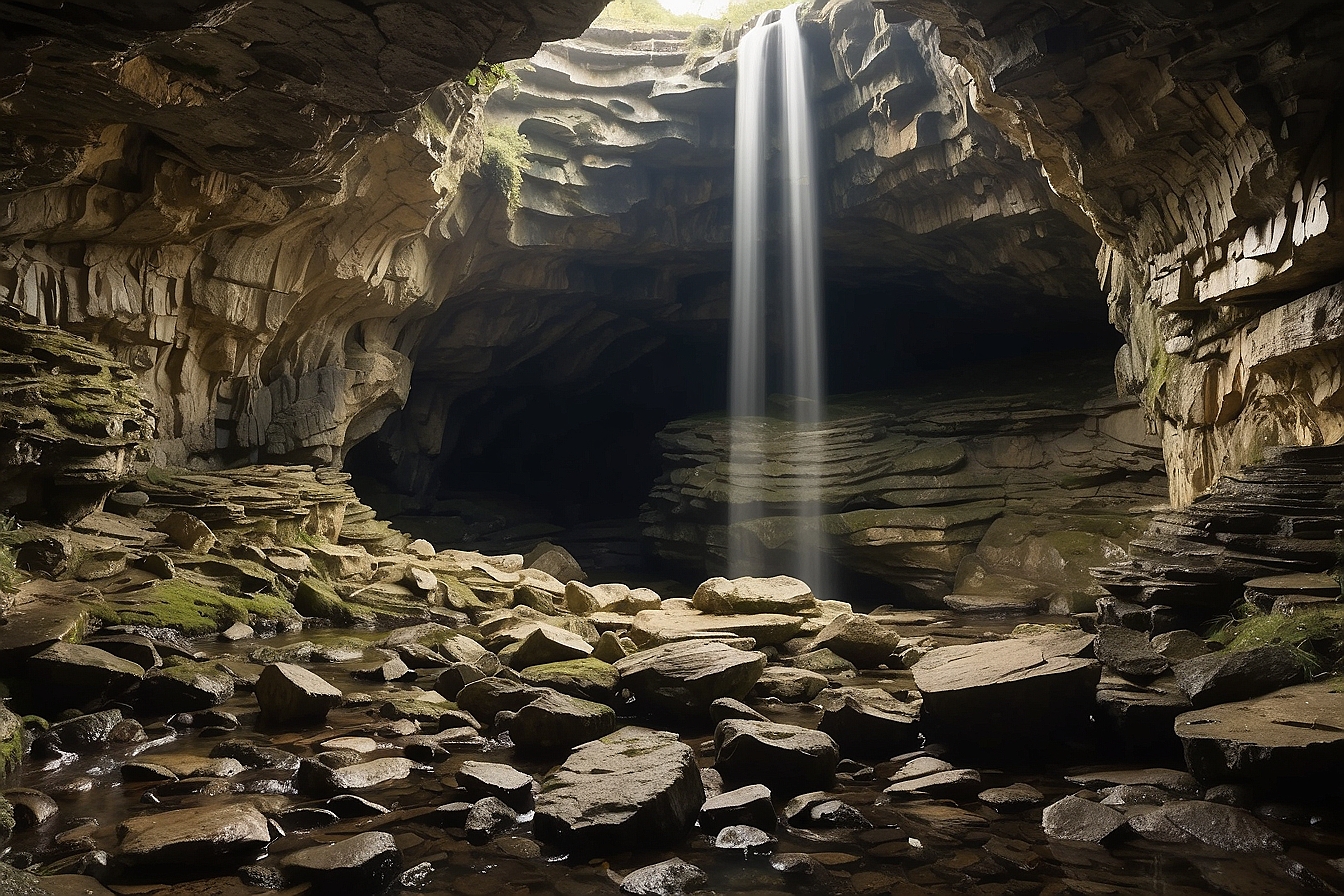
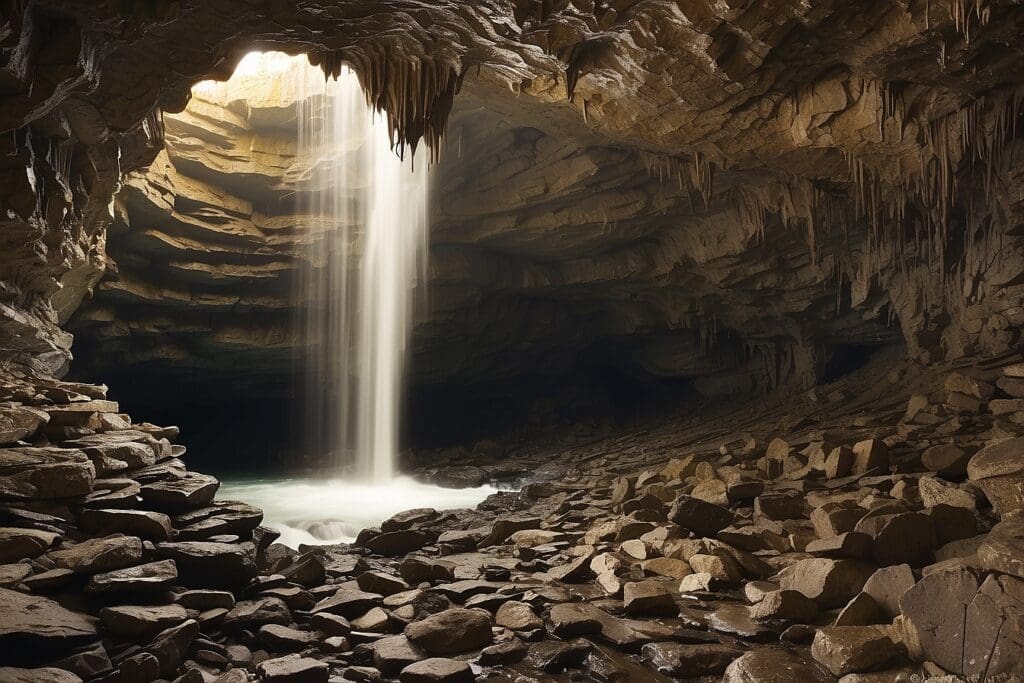
The best-known formation is the frozen cascade, a wall of calcite that reads as a waterfall stopped mid-fall and stays visible all year. It is lit deliberately, and it photographs better than most cave formations because it has genuine relief rather than a flat surface.

In the largest chamber, called the Highway, an actual waterfall runs. After heavy rain it gets loud, which is one of the few cases where visiting the Burren in poor weather improves the experience. Elsewhere you get straightforward stalactites and stalagmites, flowstone curtains and fossils visible in the passage walls.

The underground river that made all of this has mostly gone, though water still moves through the system. Irish rivers carry a heavy weight of story with them, above ground and below, as ConnollyCove’s guide to the mythology of Irish rivers explores.

Mud Hall and the Cave’s Oldest Record

Mud Hall holds the oldest legible record in the cave, and it is on the ceiling rather than the floor. Cut into the roof are networks of twisting tubes called anastomoses, formed by a small stream working along a bedding plane above a layer of mud.

They are easy to miss if the guide does not point them out. They are also the clearest evidence in the cave of how the system began, long before the chambers you are standing in existed.

The Bear Pits and Ireland’s Last Bears

Ailwee’s most distinctive feature is not a rock formation. It is a set of shallow depressions in the cave floor near the entrance, understood as hibernation hollows made by European brown bears, along with the bones they left behind.

The dating is remarkable. A bear skull from the cave has been radiocarbon dated to roughly 10,400 years old. That places it in the Early Mesolithic and makes it one of the oldest known bear remains in Ireland.

A bear tibia from the same cave dates to around 4,600 years old and carries butchering marks. People were handling bear carcasses in the Burren during the Late Neolithic, when the Poulnabrone portal tomb a short drive away was already standing. Brown bears have been extinct in Ireland for roughly three thousand years. Bears held real symbolic weight in early Irish and wider Celtic belief, a subject ConnollyCove takes up in the guide to animals in Celtic mythology and folklore.

Life Underground and the Karst Above

Ailwee shelters one of Ireland’s rarest bats, and the hillside outside it grows plants that have no business sharing a habitat. Both are reasons the wider area holds UNESCO Global Geopark status.

The cave is not a rich habitat in the way a woodland is. What lives here is specialised.

Ireland’s Rarest Bat

The lesser horseshoe bat roosts in the darker parts of the cave. In Ireland and Britain it survives only along the western coasts. Its hibernation is extreme. The animal drops its heart rate to a fraction of the waking figure during deep torpor, running its metabolism at a crawl to get through winter.

You are unlikely to see one on a tour, and that is intentional. Roosting bats are disturbed by light and noise, and the lit sections of the route are kept away from where they gather. Species like this depend on people accepting limits on access. That is a much older idea in Irish tradition than the word conservation suggests, as ConnollyCove’s piece on Irish folklore and environmental conservation sets out.

Mosses, Ferns and the Karst Flora Above

Inside the cave entrance, mosses and ferns hold on wherever a little daylight reaches, and small invertebrates work the damp floor. It thins out fast as the light stops.

Outside is where the botany gets strange. The thin soil in the grikes supports Arctic, Alpine and Mediterranean plants growing side by side, an arrangement found almost nowhere else in Europe. The hazel woodland on the terraces below the cave is scrub that has been left alone. Hazel carries its own place in Irish belief, as do the fairy trees of Ireland still standing in field corners across the country.

Beyond the Cave: Birds of Prey, Burren Gold and the Woodland Walk

The three surface attractions at Ailwee are the reason this site works as a half-day rather than a 45-minute stop. For families they are frequently the better half of the visit. All three are on the same site as the cave entrance.

The visitor complex itself has some standing. It holds a Europa Nostra prize, awarded for heritage conservation and interpretation.

The Birds of Prey Centre and Flying Displays

The Burren Birds of Prey Centre keeps eagles, hawks, owls, falcons and vultures, and runs interactive flying displays through the day. Displays typically go out at 11.30am, 1.30pm and 3.30pm, weather permitting. Time your cave tour around one rather than hoping.

Hawk walks, where you carry a bird on the glove along a set route, are bookable separately. They are the closest thing on site to a genuinely memorable hour, and they book out.

The Farm Shop and Burren Gold Cheese

The farm shop is a working cheese dairy, not a gift counter. Burren Gold is made on site by traditional methods and you can watch the process. Varieties include nettle-and-garlic and oak-smoked alongside the plain.

The makers argue that the flavour comes from cattle grazing the herb-rich grass in thin soil over limestone. It is the same claim made for a good deal of west of Ireland dairy, and it is more persuasive here than in most places. Cheese of this kind belongs in the same conversation as the rest of traditional Irish food, which has moved a long way from the stereotype in the last two decades.

The Biodiversity Woodland Walk

The self-guided woodland walk climbs through the hazel on the terraced slope above the shop, with interpretation boards on the karst flora. It takes about half an hour at a slow pace.

Do this one for the view as much as the plants. The viewpoints frame Galway Bay, and on a clear evening it is the best thing on the site.

Ailwee Caves or Doolin Cave: Which Suits Your Trip?

Choose Ailwee if you are travelling with children or want a half-day site. Choose Doolin if you want one extraordinary object and do not mind 125 steps. They are twenty minutes apart, both in the Burren, and most travellers only have time for one.

Neither is a substitute for the other. They are genuinely different visits, and the table below is the comparison the search results do not currently offer.

Ailwee CaveDoolin Cave
Headline featureFrozen cascade, waterfall, prehistoric bear pitsThe Great Stalactite, 7.3 metres, around 10 tonnes
Tour lengthAbout 45 minutesAbout 60 minutes
Steps24 steps down, two bridges125 steps down and back up
RouteCircular, roughly 1 km, around 90 m deepTwo chambers, roughly 60 m deep
Hard hatsNot requiredRequired
Suits childrenAll ages permittedBetter suited from about age 8
Also on siteBirds of prey centre, cheese dairy, woodland walkEco-trail, pottery studio, cafe
OpenDaily from 10am, reduced winter accessYear-round, seasonal hours

Choose Ailwee If

Ailwee wins on breadth. The birds of prey displays give restless children something to do that is not a cave. The cheese dairy gives adults something to do that is not a gift shop. The physical demand is modest enough for most fitness levels.

It also wins on story. The bear pits and the McGann discovery give the guide real material, and the tour is better for it.

Choose Doolin If

Doolin wins on spectacle. The Great Stalactite is the longest free-hanging stalactite in Europe at 7.3 metres, weighing about ten tonnes. Standing under it is a different order of experience from looking at a good calcite wall.

The trade-off is the 125 steps in each direction, roughly an eight-storey building, and hard hats throughout because the passage is low in places. Fine for most adults, harder with small children or dodgy knees.

Planning Your Visit: Getting There, Access and What to Expect

Ailwee needs about two hours for the full site and 45 minutes for the cave alone, and it is the strongest wet-weather option in the northern Burren. Book the cave tour in advance in summer and around the Christmas period.

Admission fees apply and change. The operator publishes current prices and times, and we have deliberately not printed figures here that will be wrong within a season.

Getting There

You will need a car or a tour bus. Ailwee is roughly 40 minutes from Galway city and about the same from Shannon Airport, signposted off the coast road above Ballyvaughan, with parking at the visitor centre.

The approach from the south involves Corkscrew Hill, a series of tight switchbacks climbing out of the Ballyvaughan valley. It is a normal Irish regional road and perfectly manageable. Visitors used to wide North American lanes routinely find it the most nerve-testing driving of their trip, so take it slowly and use the pull-ins.

Anyone building Ireland into a short trip from Britain will find the logistics in ConnollyCove’s guide to a day trip to Ireland from London useful. It helps work out how much of Clare fits into the time available.

Accessibility and What to Expect Physically

The cave tour is not suitable for wheelchairs, buggies or walking frames. The operator is explicit about this. The passageways are too narrow and there are 24 steps to descend within the route.

Children of all ages are allowed. One practical caveat is worth knowing in advance. You can turn back at the first of the five stops if a child dislikes it, but after that stop you stay with the group to the end.

The surface attractions, the shop, the cafe and much of the site around the visitor centre are considerably more manageable. A group with mixed mobility can still make the trip work, with one person sitting out the cave.

What to Wear and Bring

Bring a light waterproof jacket and wear shoes with grip, whatever the month. The cave stays cool and damp year-round and the paths carry moisture, so August visitors in sandals regularly regret it.

Leave the tripod. Photography is fine, the lighting is low, and a phone with a steady hand does better in there than most people expect.

Current Conditions and Seasonal Information

Ailwee is open daily from 10am through most of the year. The main season runs from late March to early October, with reduced access in December by appointment. Check the operator’s site before travelling in winter.

Because the cave is underground, its conditions barely shift across the year, which inverts the usual Irish seasonal calculation. The weather outside affects the drive, the woodland walk and the flying displays, not the tour.

Season by Season

May to September gives the most reliable weather for the surface attractions and the fullest display schedule. It is also when the Burren’s flowering peaks, with late May and June the best window for the limestone flora. It is the busiest period, so book.

April and October are the value months: fewer people, displays still running, and enough daylight for the woodland walk. Winter visits are viable but need checking ahead, and the flying displays are more likely to be cancelled.

Irish weather has always been read as a set of signs rather than a forecast, and ConnollyCove’s piece on Ireland’s weather lore covers how those readings worked.

For a sense of what a summer visit involves underfoot, our guide to the weather in Ireland in June is a realistic starting point.

Booking, Displays and Making a Day of It

Book the cave tour ahead in July and August and for anything around Christmas. Flying displays run to a fixed daily schedule rather than on demand, so check times on the day and build the cave tour around them.

Poulnabrone portal tomb is a short drive south and free to visit, and the Burren’s marked walking trails are close by. Ballyvaughan has pubs worth an hour afterwards. The role those places play in Irish social life is a subject in itself, covered in the tradition and folklore of Irish pubs.

For the geology and habitat context across the whole region, the Burren and Cliffs of Moher UNESCO Global Geopark maintains a geosite record for Ailwee.

Frequently Asked Questions

These are the questions travellers actually type before booking Ailwee, drawn from People Also Ask and from the live query data for this page. The answers lead with the direct response.

How long does the Ailwee Cave tour take?

The guided tour takes about 45 minutes. It follows a circular route of roughly one kilometre with five stops, two bridges and a descent of 24 steps, and everyone goes with a guide rather than exploring alone. If you are also doing the birds of prey display, the farm shop and the woodland walk, allow around two hours for the site in total. Some older listings quote 30 or 35 minutes, which reflects the shorter route used before the tour was extended.

Who discovered Ailwee Cave?

A local farmer named Jack McGann found the cave in 1944, while following his dog as it chased a rabbit into a fissure in the hillside. He did not explore far and told nobody for nearly thirty years, finally mentioning it to cavers working the area in 1973. Some sources, including the Burren Geopark’s own geosite record, give the discovery year as 1940 rather than 1944, so the exact date is genuinely disputed. The cave opened to the public in 1976.

What does Ailwee mean in Irish?

Ailwee comes from the Irish Aill Bhuí, which means “yellow cliff”. Say it roughly as all-wee. The name describes the hillside the cave runs into rather than the cave itself, which is a common pattern in Burren place names. Boireann, the root of Burren, means “rocky place” in much the same plain way.

Is Ailwee Cave wheelchair accessible?

No. The operator states clearly that the cave tour is not suitable for wheelchairs, buggies or walking frames. The passageways are too narrow and the route includes 24 steps to descend. The visitor centre, farm shop, cafe and gift shop are far more manageable, and much of the surface site can be seen without doing the cave. Groups with mixed mobility often split, with one person waiting at the centre for the 45 minutes.

Do you have to book Ailwee Cave in advance?

Booking ahead is strongly advised in July and August and essential around the Christmas period. Outside those times you can usually turn up and join the next tour, though a busy afternoon in shoulder season can still mean a wait. December access is by appointment only. Check the operator’s site for current times before travelling in winter.

Is it cold inside Ailwee Cave?

Yes, the cave stays cool and damp year-round, so bring a light jacket even in high summer. The temperature underground barely changes between seasons, which is why a cave is a good use of a wet Clare afternoon. The paths hold moisture and can be slick in places, so shoes with grip matter more than warm clothing.

Ailwee Cave or Doolin Cave, which is better for kids?

Ailwee is generally the better choice for children. All ages are permitted on the tour, the physical demand is 24 steps rather than Doolin’s 125, and the flying displays give restless children something to do above ground. Doolin is usually recommended from about age eight upwards and requires hard hats. Ailwee also lets you turn back at the first stop if a young child dislikes the dark, though after that you stay with the group.

Where is Ailwee Cave in County Clare?

Ailwee Cave is above Ballyvaughan on the northern edge of the Burren, in the north-west of County Clare. It is roughly 40 minutes’ drive from Galway city and about the same from Shannon Airport, signposted off the coast road. The site sits high on a terraced hillside with views north over Galway Bay. Poulnabrone portal tomb and the Burren’s walking trails are a short drive south.

Why is Ailwee Cave famous?

Ailwee is known for three things. The 1944 discovery by a farmer who kept it secret for nearly thirty years. The prehistoric bear pits and bone finds. Its role as the Burren’s most accessible show cave. The bear skull recovered here dates to about 10,400 years old, among the oldest such remains in Ireland. It also appeared in the Father Ted episode “The Mainland” as “The Very Dark Caves”, which is how many Irish and British visitors first heard of it.

Explore More of Ireland’s Underground Heritage

Ailwee earns its place on a Clare itinerary on the strength of what it tells you, not the scale of what it shows you. The bear pits, the 8,000-year-old formations and a farmer’s thirty-year silence add up to a better 45 minutes than the size of the cave would suggest. The birds of prey and the cheese dairy make it a genuine half-day for families.

If you are building out a Burren trip, pair it with Poulnabrone and a walking trail, and give Ballyvaughan an hour afterwards. Ciaran Connolly founded ConnollyCove to document the places and traditions behind Irish culture, and the platform now covers Celtic mythology, Irish heritage and destinations worldwide. The ConnollyCove YouTube channel carries video guides to sites across the country if you would rather see a place before committing a morning to it.

Leave a comment

Your email address will not be published. Required fields are marked *